Deskripsi
Baby Bottle & PP Bottle Series
Stretch Blow Moulding Machine
Two-step (2-step) reheat stretch blow moulding — precision preform reheating & biaxial orientation for baby bottles, PP pharmaceutical containers, craft bottles and irregular-shaped packaging. Trusted by UK and global B2B manufacturers.
What Is a Two-Step Stretch Blow Moulding Machine?
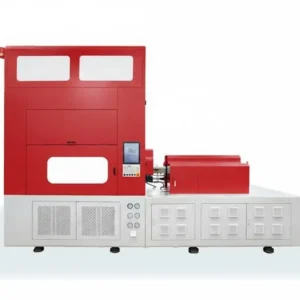
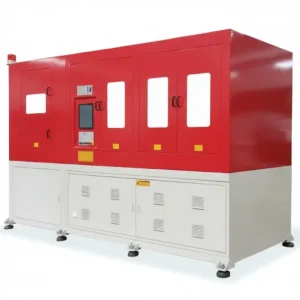
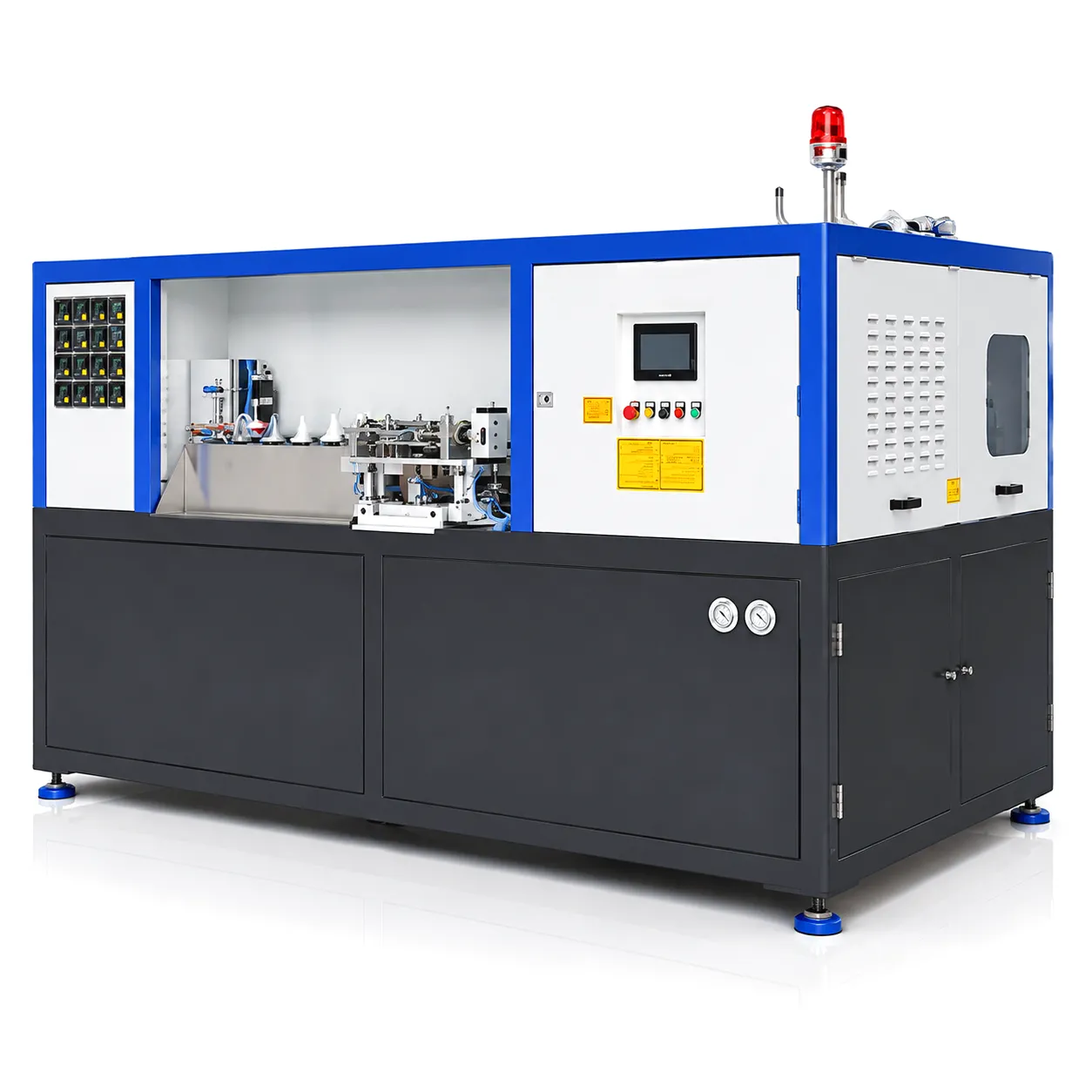 The HGA series baby bottle and PP bottle stretch blow moulding machine is a two-step (2-step) reheat blow moulding system. Unlike single-step injection blow moulding, the two-step process separates preform production from bottle blowing into two distinct stages. Preforms — already injection-moulded in a separate process — are loaded into the HGA machine, reheated to the precise orientation temperature using infrared lamp arrays, then biaxially stretched (axially by a stretch rod and radially by blow air) inside a temperature-controlled blow mould. This biaxial orientation aligns the polymer chains in both directions, delivering markedly superior clarity, impact resistance, barrier properties, and wall-thickness uniformity compared with single-step or extrusion blow moulding.
The HGA platform is specifically engineered to blow mould baby feeding bottles, PP pharmaceutical bottles, craft decorative bottles, and irregular-shaped specialty containers. It is suitable for processing PP (polypropylene), PET (polyethylene terephthalate), and PETG preforms, making it a genuinely versatile platform for UK infant care manufacturers, healthcare packaging converters, cosmetics brands, and craft spirits bottlers. The machine’s design philosophy prioritises stable, repeatable output quality — a prerequisite when production runs are audited to BRC Issue 9, GMP, or NHS procurement standards.
Two-Step Process: From Preform to Finished Bottle
The two-step process decouples preform production from blowing, giving manufacturers the flexibility to source preforms from specialist injection moulders, stockpile preforms, and operate the blow moulding machine independently at a pace matched to downstream filling and labelling capacity. For UK infant care and pharmaceutical packaging operations, this separation also simplifies material traceability and lot control documentation.
Key Advantages of the HGA Two-Step Stretch Blow Moulding Machine
Superior Optical Clarity
Biaxial orientation in the two-step stretch blow moulding process aligns polymer chains, yielding finished baby bottles and PP containers with exceptional transparency. For PP baby bottles, this clarity is a direct commercial advantage in UK retail — consumers and procurement buyers can visually inspect fill volume and product integrity through the bottle wall.
Precise Multi-Zone Heating Control
Independent infrared heating zone control across the preform length ensures the correct temperature profile for each preform geometry. Inconsistent reheat temperature is the primary cause of uneven wall thickness in two-step blow moulding — the HGA’s zone-by-zone PID control eliminates this variable, keeping CPK values above 1.33 across production runs.
Wide Container & Preform Compatibility
The HGA series processes preforms across a broad range — from compact 50 mm neck baby bottle preforms to wide-mouth 168 mm neck containers. Container volumes from 100 ml through 15,000 ml are achievable, covering the full range from 125 ml infant feeding bottles to 10-litre bulk PP containers. Single, dual, and four-cavity configurations scale output from 600 to 2,800 bph.
CE-Ready Safety Architecture
Full-perimeter interlocked guarding, emergency-stop circuits, and CE-structured electrical schematics reduce compliance lead time for UK buyers operating under the Machinery Directive and PSSR 2000. The safety design is particularly relevant for infant care and pharmaceutical packaging customers, where machinery safety forms part of site BRC and GMP audit scope.
Energy-Efficient IR Heating
Rated heating power ranges from 12 kW (compact single-cavity models) to 85 kW (large-format dual-cavity), with running consumption significantly lower thanks to PID zone switching. The infrared lamp layout is optimised for uniform preform wall penetration, minimising energy wasted on surface overheating — an important consideration for UK factories operating under DEA energy monitoring obligations.
Fast Mould & Preform Changeover
Standardised blow mould platen dimensions and a modular stretch-rod assembly allow bottle format changeovers without specialist tooling. For UK contract blow moulders running multiple baby bottle and PP bottle SKUs across a single shift, the changeover architecture translates directly to additional billable output hours per week.
Product Samples — Bottles Produced by This Machine
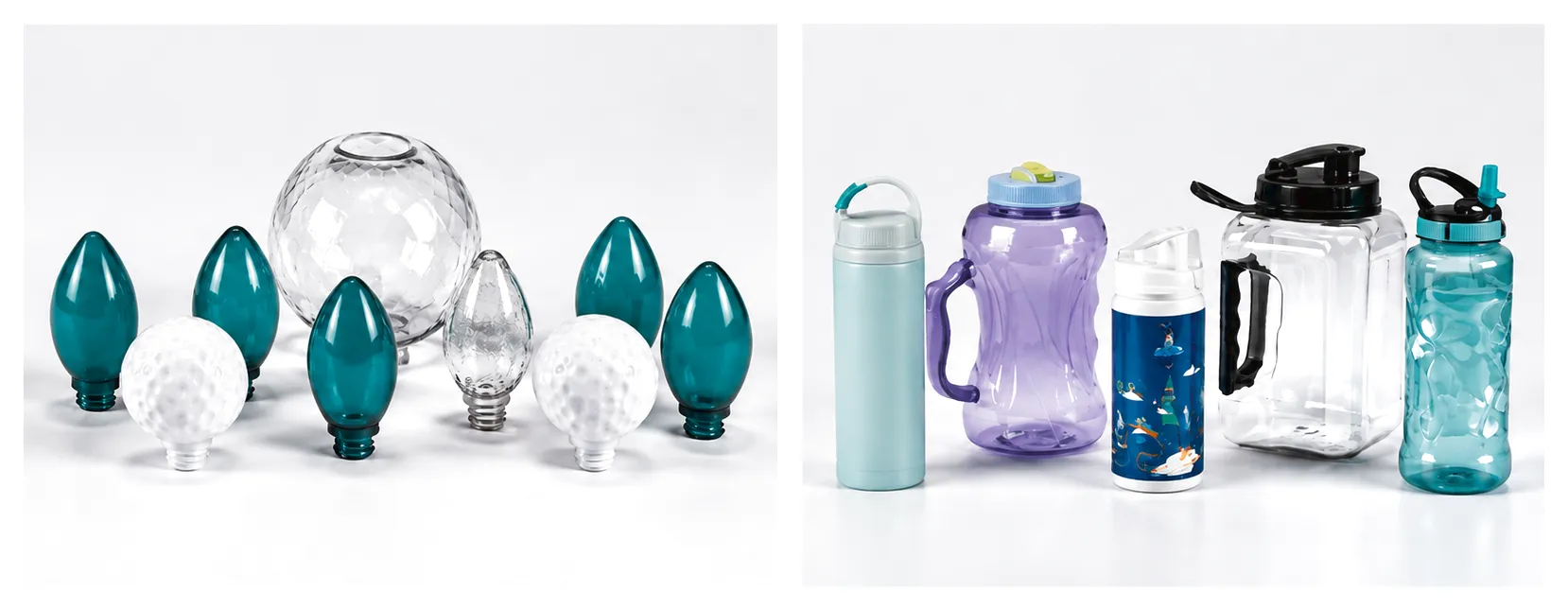
Typical output: PP baby feeding bottles, wide-neck pharmaceutical PP bottles, craft decorative bottles, and irregular-shaped containers. Biaxial orientation in the two-step process delivers exceptional wall-thickness uniformity and optical clarity across every production lot.
Materials & Application Scenarios
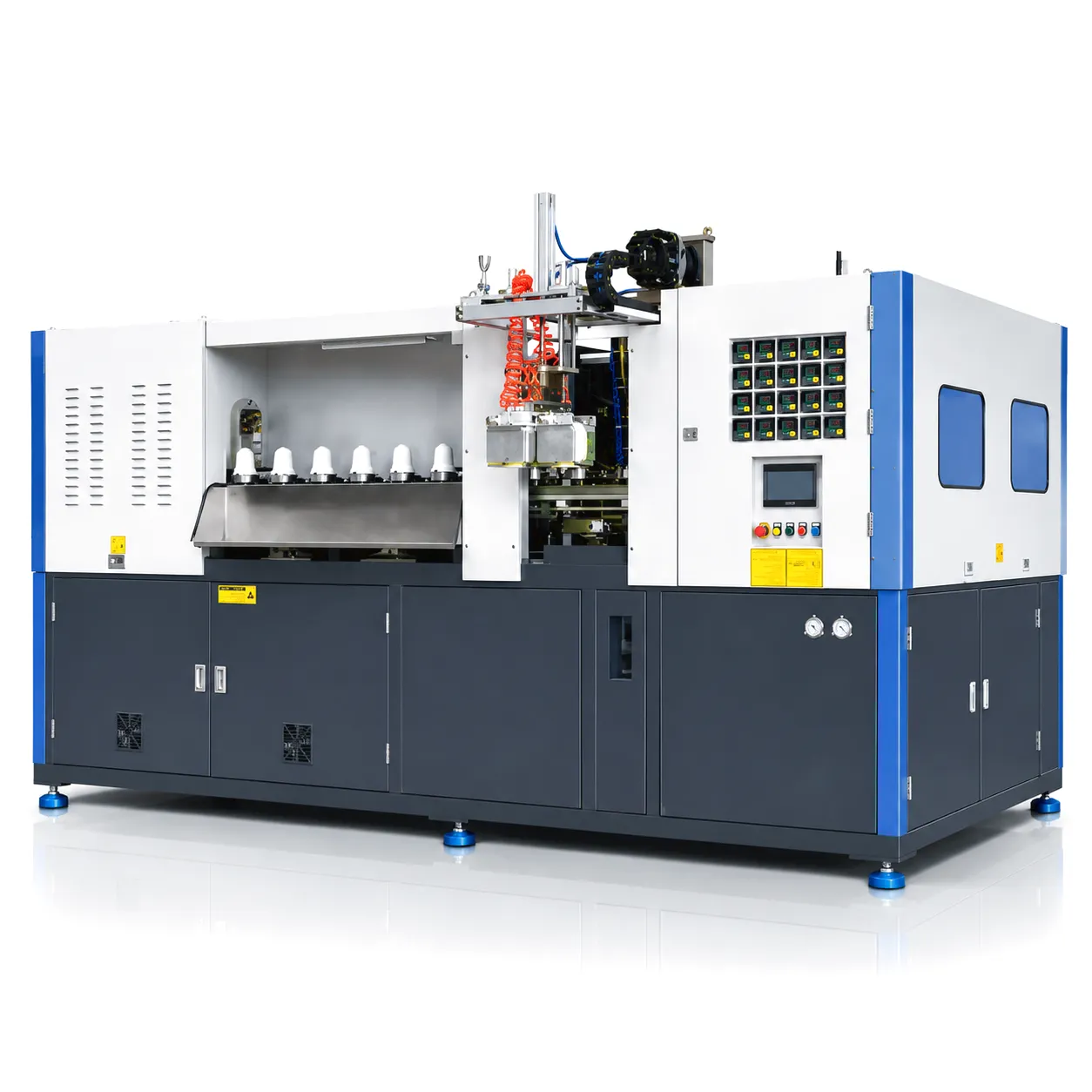 The HGA two-step stretch blow moulding machine processes injection-moulded preforms manufactured from PP (polypropylene), PET (polyethylene terephthalate), and PETG. PP is the dominant material for baby bottle production due to its food-contact safety, sterilisation resistance (autoclave and microwave), and regulatory acceptance under EU Food Contact Regulation 10/2011 and UK equivalent retained legislation. PET is specified where maximum clarity, carbonation retention, or barrier performance is required. PETG suits applications requiring unusual transparency combined with cold-filling compatibility.
In the UK market, the primary application sectors for this stretch blow moulding machine are infant feeding bottle production for NHS and retail supply chains; pharmaceutical packaging (dropper bottles, syrup bottles, and oral liquid containers) requiring traceability under MHRA manufacturing authorisations; premium cosmetics and personal care packaging for UK retail; craft spirits and artisan gin decorative bottles; and agricultural chemical containers where wall thickness uniformity is a regulatory compliance requirement. The two-step process is particularly well suited to any application where container clarity, surface gloss, and consistent dimensional accuracy are commercially or regulatory critical.
Technical Specifications
Full parameters across all 12 HGA series two-step stretch blow moulding models. Scroll horizontally on mobile.
| Category | Parameter | Unit | HGA.FS- 1CG130 | HGA.FS- 1CG150 | HGA.FS- 1CG196 | HGA.FS- 1CG220 | HGA.P.FS- 2CB130(L) | HGA.P.FS- 2CB130 | HGA.P.FS- 2CG130(L) | HGA.ES- 2C150 | HGA.P.FS- 2C150(L) | HGA.ES- 2C200 | HGA.ES- 2C260 | HGA.JS- 4C114 |
|---|---|---|---|---|---|---|---|---|---|---|---|---|---|---|
| Molding | Clamping Stroke | mm | 150 | 200 | 225 | 225 | 160 | 150 | 150 | 190 | 190 | 215 | 275 | 132 |
| Mould-Open Distance | mm | 330 | 430 | 509 | 509 | 360 | 350 | 330 | 440 | 440 | 499 | 635 | 362 | |
| Mould-Close Distance | mm | 180 | 230 | 284 | 284 | 200 | 200 | 180 | 250 | 250 | 284 | 360 | 230 | |
| Stretching Stroke | mm | 350 | 400 | 450 | 500 | 350 | 350 | 350 | 450 | 500 | 500 | 550 | 350 | |
| Bottom Mould-Open Distance | mm | 50 | 50 | 50 | 50 | 50 | 50 | 50 | 50 | 50 | 50 | 50 | 50 | |
| Bottle Mould-Close Distance | mm | 130 | 150 | 196 | 220 | 130 | 130 | 130 | 150 | 150 | 200 | 260 | 114 | |
| Preform Holder | — | 50 | 42 | 40 | 40 | 74 | 89 | 92 | 60 | 85 | 50 | 42 | 488 | |
| Cavities | — | 1 | 1 | 1 | 1 | 2 | 2 | 2 | 2 | 2 | 2 | 2 | 4 | |
| Container | Max. Container Volume | ml | 1500 | 2500 | 5000 | 5000 | 1000 | 1500 | 1500 | 2500 | 4000 | 5000 | 15000 | 1000 |
| Max. Neck Diameter Range | mm | 98 | 110 | 110 | 138 | 100 | 50 | 100 | 110 | 110 | 138 | 168 | 40 | |
| Max. Container Diameter | mm | 110 | 130 | 170 | 190 | 110 | 110 | 110 | 130 | 130 | 180 | 240 | 94 | |
| Max. Container Height | mm | 250 | 250 | 330 | 330 | 250 | 250 | 250 | 250 | 300 | 350 | 450 | 250 | |
| Theoretical Output | bph | 700 | 700 | 600 | 600 | 700 | 1000 | 700 | 1800 | 800 | 1600 | 900 | 2800 | |
| Electrical System | Max. Heating Power | kW | 16 | 12 | 24 | 36 | 66 | 45 | 69 | 42.5 | 48 | 85 | 68 | 64 |
| Running Heating Power | kW | 10 | 10 | 12 | 14 | 38 | 13–15 | 40–42 | 18 | 22 | 35 | 35 | 30 | |
| Air System | Operating Pressure | kg/cm² | 7 | 7 | 7 | 7 | 7 | 7 | 7 | 7 | 7 | 7 | 7 | 7 |
| Low Pressure Air Consumption | ltr/min | 800 | 800 | 800 | 800 | 1500 | 1500 | 1500 | 600 | 1600 | 600 | 1200 | 800 | |
| Blowing Pressure | kg/cm² | 35 | 35 | 30 | 30 | 30 | 35 | 30 | 26–35 | 35 | 30 | 35 | 30 | |
| High Pressure Air Consumption | ltr/min | 1200 | 2000 | 3500 | 3500 | 1000 | 1500 | 1200 | 1000–1500 | 1200 | 6000 | 16000 | 3000 | |
| Cooling Wate | Operating Pressure | kg/cm² | 5–6 | 5–6 | 5–6 | 5–6 | 5–6 | 5–6 | 5–6 | 5–6 | 5–6 | 5–6 | 5–6 | 5–6 |
| Temperature | °C | 8–10 | 8–12 | 8–12 | 8–12 | 8–10 | 8–10 | 8–10 | 8–10 | 8–10 | 8–12 | 8–10 | 8–10 | |
| Flow Rate | ltr/min | 30 | 30 | 30 | 30 | 30 | 30 | 30 | 30 | 30 | 91.4 | 50 | 60 | |
| Machine | Size L×W×H | mm | 3160×1500×1800 | 3100×1450×1800 | 3510×1830×2000 | 4200×2070×2000 | 4510×1800×2050 | 2520×1635×1950 | 3820×1940(2800)×1880 | 4290×1800×2220 | 3250×1700×1810 | 4300×2100×2500 | 5570×2090×2500 | 6010×2150×2130 |
| Machine Weight | kg | 2000 | 2500 | 2800 | 3200 | 4000 | 2500 | 4000 | 3500 | 6500 | 4500 | 7500 | 6500 |
Factory Capabilities & Custom Configuration Service
Our manufacturing facility operates ISO 9001:2015-certified production lines covering full vertical integration — from precision IR lamp housing fabrication and stretch-rod assembly machining to complete machine assembly, electrical wiring, PLC programming, and pre-shipment factory acceptance testing. The factory engineering team has delivered two-step stretch blow moulding machine installations across more than 30 countries over two decades. UK customers benefit from dedicated pre-sales engineering consultation, CE certification documentation preparation, and post-installation remote support via PLC access.
Custom configurations are central to our offer. Services available to UK buyers include: non-standard platen adaptation for existing blow moulds; bespoke IR lamp zone count and spacing to match specific preform geometries (including wide-neck PP baby bottle preforms); integration of inline leak-testing, automated preform orientation, and conveyor outfeed systems; custom electrical panel re-configuration to UK 18th Edition wiring regulations; and application-specific stretch-rod length and diameter modification. If your two-step stretch blow moulding requirement is not covered by the standard model range, our applications team will assess feasibility and submit a written proposal within five working days of receiving your preform sample and bottle drawing.
Customer Success Stories
Background: A West Yorkshire infant care brand supplying NHS-registered PP baby feeding bottles to major UK supermarket chains needed to upgrade their two-step blow moulding capacity. Their existing single-cavity reheat blow moulding machine was unable to maintain wall thickness uniformity to within their internal ±0.15 mm tolerance across a full eight-hour shift — a compliance risk against their BRC Issue 9 audit schedule and a commercial risk given retailer-driven quality scorecards.
Solution: We supplied and commissioned the HGA.P.FS-2CB130 two-cavity two-step stretch blow moulding machine, with an eight-zone IR heating array calibrated specifically for their Borealis PP preform wall geometry. Pre-shipment FAT included full CPK measurement at rated throughput. On-site commissioning was completed in seven working days including mould validation and operator training.
Result: Wall thickness CPK improved from 0.91 (old machine) to 1.48 (HGA machine) within the first production week. Scrap rate dropped from 4.2% to 1.6%. The customer passed their subsequent BRC audit with zero major non-conformances against packaging equipment.
“We switched from a single-step injection blow moulding machine to the HGA two-step platform. The PP bottle clarity is noticeably better — our retail customer commented on it without prompting. The machine has run for eight months without a single unplanned stoppage.”
“We were initially sceptical about buying a two-step stretch blow moulding machine from a Chinese supplier, but the factory visit and pre-shipment testing settled it. The technical support during commissioning was better than we received from a European OEM on our previous line.”
“We produce craft gin bottles in an irregular faceted design — a shape most blow moulding machine suppliers said would need design compromise. The HGA engineering team reviewed our mould drawing and confirmed compatibility before we placed the order. No surprises on arrival.”
Related Equipment: Injection Blow Moulding Machines
For UK manufacturers requiring single-step injection blow moulding — where preform injection, conditioning, and bottle blowing happen in a single integrated machine — our injection blow moulding machine range offers an alternative route. Single-step machines eliminate separate preform procurement and inventory management, making them particularly suitable for very high-precision pharmaceutical dropper bottles and cosmetics containers where neck flash-free finish is a hard specification requirement.
A direct-fit replacement for the Uniloy UIB 180 injection blow moulding platform. Suitable for pharmaceutical and personal care bottle lines requiring precise neck geometry at scale.
The ZQ110 replicates the footprint and tooling compatibility of the Uniloy UIB 150, offering an upgrade path for existing UK injection blow moulding lines without full mould reinvestment.
Frequently Asked Questions
Ready to discuss your two-step stretch blow moulding machine requirements for UK production?
📧 Get a Quote — [email protected]
ISBM Equipment Ltd · Two-Step Stretch Blow Moulding Machine Specialists · Serving UK & European Industry · edit by gzl