คำอธิบาย
Two-Step PET Blow Moulding Technology
Crafts & Special-Shaped Bottle Series Blow Moulding Machine
Engineered for UK and European manufacturers demanding precision, flexibility, and speed — this two-step blow moulding machine handles everything from baby bottles and PP containers to complex craft and irregular-profile vessels.
What This Machine Actually Does
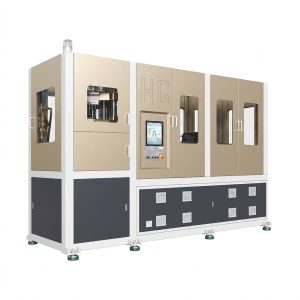
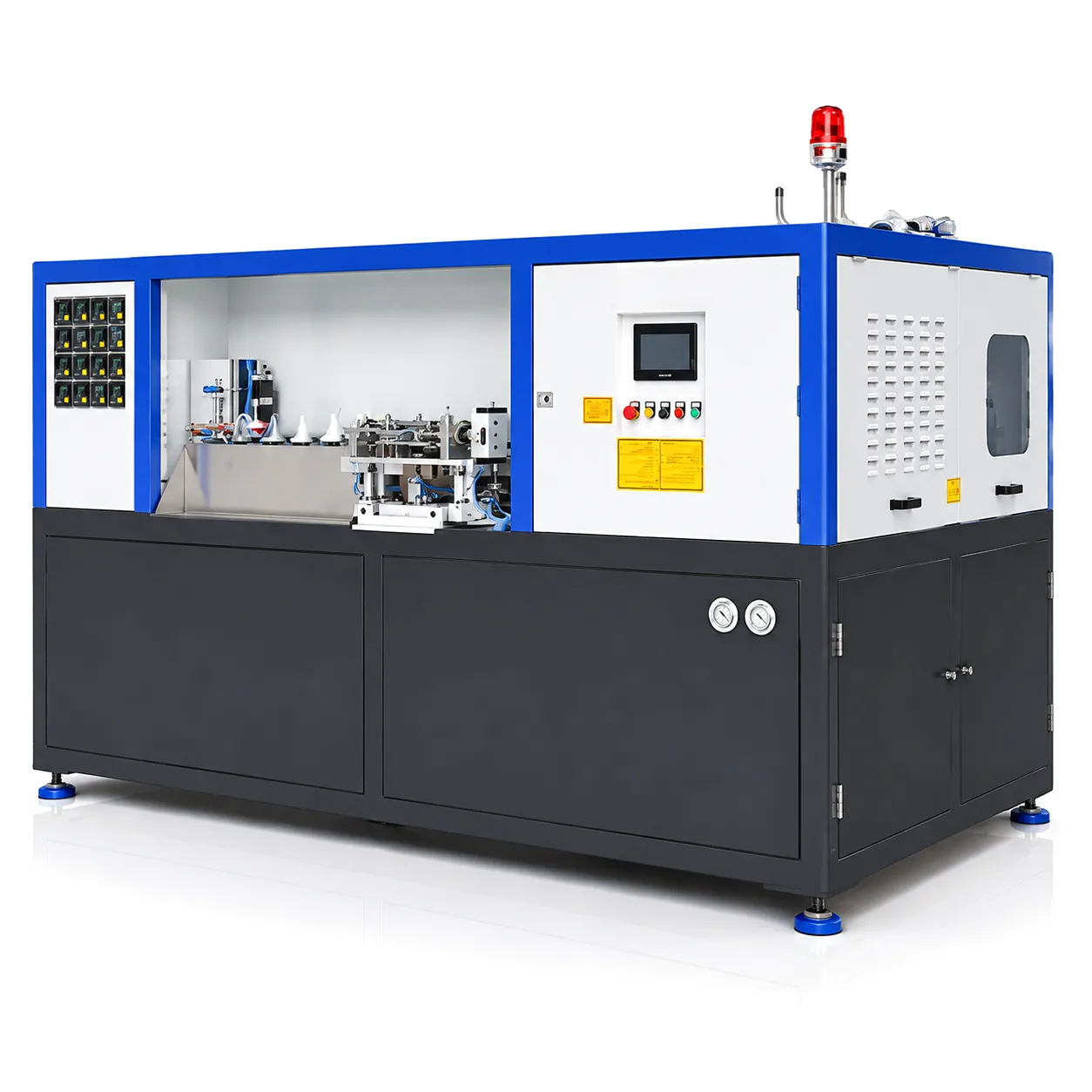 The HGA Series Crafts and Special-Shaped Bottle Blow Moulding Machine is a professional two-step (two-stage) stretch blow moulding system designed for producing containers with non-standard or complex geometries. Unlike conventional single-step systems, the two-step process separates preform injection from the blow moulding stage entirely. Preforms are produced or sourced separately and then reheated and stretched within this machine to create the finished container. This separation gives manufacturers far greater control over wall thickness uniformity, material distribution, and output scheduling — particularly valuable when running short runs of specialised vessels or switching between different bottle formats across a UK packaging operation.
Suitable for blowing baby feeding bottles, PP bottles, craft gift containers, and irregularly shaped vessels of varying sizes, the machine delivers consistent quality across all cavity configurations. The design accommodates container capacities from 1,000 ml up to 15,000 ml depending on the model variant, with neck diameters ranging from 40 mm to 168 mm. Whether a UK packaging converter needs to produce decorative glass-look PET jars or an OEM plastic parts manufacturer is scaling up PP bottle output, this platform covers both standard and bespoke production requirements without requiring a separate dedicated line for each product type.
Produced Sample Containers
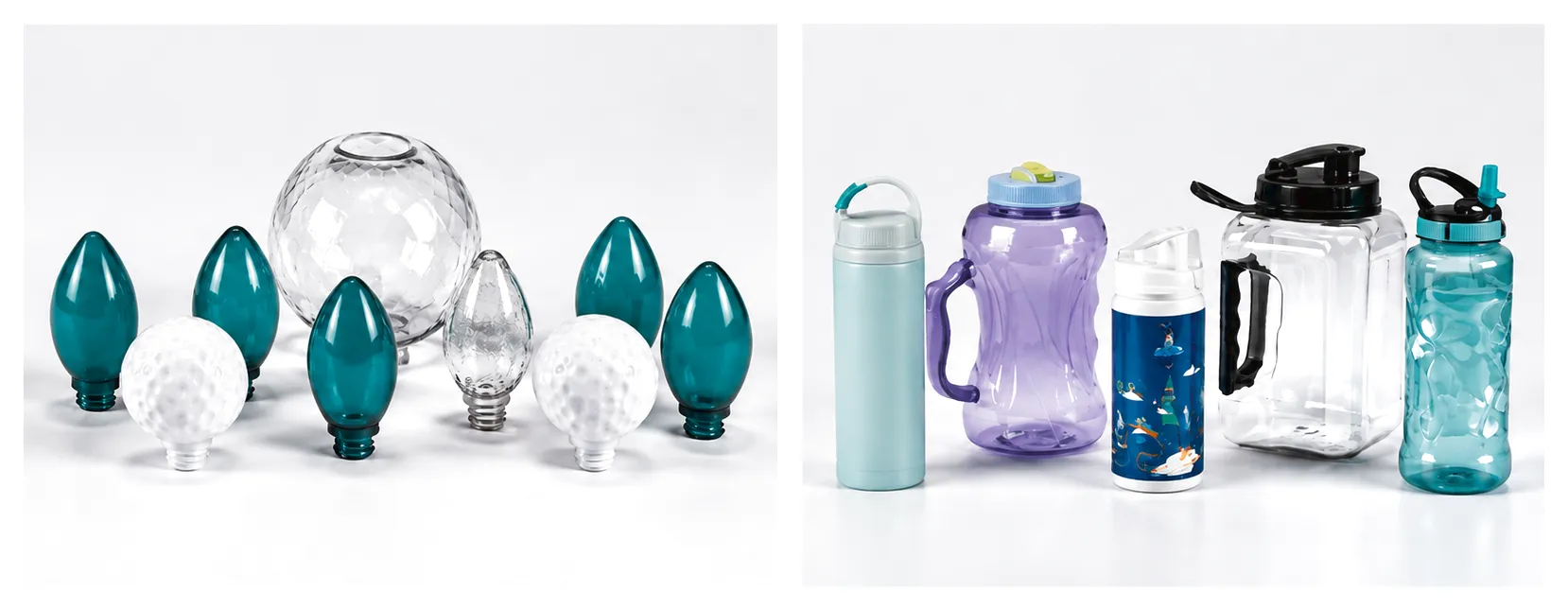
Sample output: craft bottles, PP containers, and special-shaped vessels from the HGA Series line
Why UK Manufacturers Choose This Machine
Two-Step Flexibility
Decoupled preform and blow stages mean you can switch container formats, change cavity counts, or use third-party preforms without retooling the entire line. Run one SKU in the morning and a completely different bottle profile in the afternoon.
Wide Container Range
From compact 1,000 ml baby bottles to large 15,000 ml craft or industrial containers, the HGA series spans a capacity range few competing platforms match. Maximum container height reaches 450 mm and diameter 240 mm, accommodating unusually tall or wide vessel profiles.
High Theoretical Output
Depending on model, rated theoretical output reaches up to 2,800 bottles per hour. The HGA.JS-4C114 four-cavity configuration is engineered specifically for high-volume scenarios where throughput-per-floor-area matters, without sacrificing surface finish on complex geometries.
Stable and Reliable Performance
The machine’s pneumatic, hydraulic, and cooling systems are independently regulated, keeping process variables stable across long production runs. Operating pressure sits at 7 kg/cm2 for air, with a separate 5-6 kg/cm2 blowing circuit, and cooling water flow is managed at 30 ltr/min across most models.
Custom Tooling and Mould Support
We supply matched mould sets for all standard container profiles and accept bespoke mould specifications for craft, cosmetic, food, and specialty industrial bottles. Preform holder counts range from 40 to 488, and cavity configurations cover 1, 2, and 4 cavities depending on the model.
Energy-Efficient Heating
Max heating power reaches 85 kW on the larger ES-2C200 model, while actual running heating power in typical cycles is substantially lower — delivering cost-effective thermal performance even for UK facilities operating under rising energy costs. Cooling water temperature range of 8-12 degrees C is easily met by standard chiller systems used in British plastics plants.
Working Principle, Materials and Applications
Two-Step Process Explained
In the two-step blow moulding process, preforms are manufactured independently — either in-house on a separate injection moulding machine or purchased from a specialist preform supplier. These preforms are then loaded into the HGA machine, where an infrared heating station brings them to the precise stretch temperature (typically 90-120 degrees C for PET). A stretch rod then extends the preform axially while high-pressure air inflates it radially into the mould cavity. Because heating and blowing are in separate machines, operators can stockpile preforms, run blow moulding at a different pace from injection, and switch container designs simply by changing moulds and preform specifications — a major advantage for UK converters managing multiple SKUs or seasonal packaging runs.
Compatible Materials
The HGA Series is engineered to process PET (polyethylene terephthalate) and PP (polypropylene) as primary resins. PET is the most widely used material for clear beverage bottles, cosmetic containers, and food-grade packaging across the UK market. PP is preferred for opaque or semi-translucent applications including baby feeding bottles, personal care products, and certain pharmaceutical containers. For special-shaped craft and decorative bottles, colour masterbatch compatibility allows vivid, uniform colouration without surface defects. The clamping and stretching stroke parameters vary per model to accommodate the different melt behaviour and wall thickness requirements of these two resin families.
Application Scenarios
- Baby feeding bottles and infant care containers
- Craft and gift packaging — decorative, irregular, or faceted vessel shapes
- PP wide-mouth jars for food (honey, condiments, protein powder)
- Cosmetic and personal care bottles with complex shoulder geometry
- Pharmaceutical and nutraceutical containers
- Special-shaped industrial fluid bottles requiring pressure resistance
- Beverage containers: juices, functional drinks, water dispensers
- Arts and homeware gift items requiring unique silhouettes
Technical Specifications
All parameters shown are for standard production configuration. Custom specifications available on request.
| Category / Parameter | Unit | HGA.FS-1CG130 | HGA.FS-1CG150 | HGA.FS-1CG196 | HGA.FS-1CG220 | HGA.P.FS-2CB130(L) | HGA.P.FS-2CB130 | HGA.P.FS-2CG130(L) | HGA.ES-2C150 | HGA.P.FS-2C150(L) | HGA.ES-2C200 | HGA.ES-2C260 | HGA.JS-4C114 | |
|---|---|---|---|---|---|---|---|---|---|---|---|---|---|---|
| Molding | Clamping Stroke | mm | 150 | 200 | 225 | 225 | 160 | 150 | 150 | 190 | 190 | 215 | 275 | 132 |
| Mold-open Distance | mm | 330 | 430 | 509 | 509 | 360 | 350 | 330 | 440 | 440 | 499 | 635 | 362 | |
| Mold-close Distance | mm | 180 | 230 | 284 | 284 | 200 | 200 | 180 | 250 | 250 | 284 | 360 | 230 | |
| Stretching Stroke | mm | 350 | 400 | 450 | 500 | 350 | 350 | 350 | 450 | 500 | 500 | 550 | 350 | |
| Bottom Mold-open Distance | mm | 50 (all models) | ||||||||||||
| Preform Holder | — | 50 | 42 | 40 | 40 | 74 | 89 | 92 | 60 | 85 | 50 | 42 | 488 | |
| Cavities | — | 1 | 1 | 1 | 1 | 2 | 2 | 2 | 2 | 2 | 2 | 2 | 4 | |
| Container | Max Container Volume | ml | 1500 | 2500 | 5000 | 5000 | 1000 | 1500 | 1500 | 2500 | 4000 | 5000 | 15000 | 1000 |
| Max Neck Diameter Range | mm | 98 | 110 | 110 | 138 | 100 | 50 | 100 | 110 | 110 | 138 | 168 | 40 | |
| Max Container Diameter | mm | 110 | 130 | 170 | 190 | 110 | 110 | 110 | 130 | 130 | 180 | 240 | 94 | |
| Max Container Height | mm | 250 | 250 | 330 | 330 | 250 | 250 | 250 | 250 | 300 | 350 | 450 | 250 | |
| Theoretical Output | bph | 700 | 700 | 600 | 600 | 700 | 1000 | 700 | 1800 | 800 | 1600 | 900 | 2800 | |
| Electrical System | Max Heating Power | kW | 16 | 12 | 24 | 36 | 66 | 45 | 69 | 42.5 | 48 | 85 | 68 | 64 |
| Routine Heating Power | kW | 10 | 10 | 12 | 14 | 38 | 13-15 | 40-42 | 18 | 22 | 35 | 20 | 30 | |
| Air System | Operating Pressure | kg/cm2 | 7 (all models) | |||||||||||
| Low Pressure Air Consumption | ltr/min | 800 | 800 | 800 | 800 | 1500 | 1500 | 1500 | 600 | 1600 | 600 | 1200 | 800 | |
| Blowing Pressure | kg/cm2 | 35 | 35 | 30 | 30 | 30 | 35 | 30 | 26-35 | 35 | 30 | 35 | 30 | |
| Cooling Water | Operating Pressure | kg/cm2 | 5-6 (all models) | |||||||||||
| Temperature Range | deg C | 8-10 | 8-12 | 8-12 | 8-12 | 8-10 | 8-10 | 8-10 | 8-10 | 8-10 | 8-12 | 8-10 | 8-10 | |
| Flow Rate | ltr/min | 30 | 30 | 30 | 30 | 30 | 30 | 30 | 30 | 30 | 91.4 | 50 | 60 | |
| Machine | Size (L x W x H) | mm | 3160x1500x1800 | 3100x1450x1800 | 3510x1830x2000 | 4200x2070x2000 | 4510x1800x2050 | 2520x1635x1950 | 3820×1940(2800)x1880 | 4290x1800x2220 | 3250x1700x1810 | 4300x2100x2500 | 5570x2090x2500 | 6010x2150x2130 |
| Machine Weight | kg | 2000 | 2500 | 2800 | 3200 | 4000 | 2500 | 4000 | 3500 | 6500 | 4500 | 7500 | 6500 | |
Our Factory and Custom Engineering Capability
We operate a fully integrated blow moulding machine manufacturing facility where every core mechanical assembly — from the clamping unit to the infrared heating chain — is produced in-house. This vertical integration allows us to offer a level of customisation that off-the-shelf machine suppliers simply cannot match. If your packaging application requires a container shape, neck finish, or capacity that does not fit a standard model, our engineering team can modify the machine platform, redesign the mould, or develop an entirely new tooling configuration around your preform specification. UK customers in craft beverages, specialty food, infant care, and luxury cosmetics regularly commission bespoke configurations from us, and we handle the full project from DXF/3D mould data review through to FAT (Factory Acceptance Test) before shipment.
Customer Success: Real Results
A selection of projects where the HGA blow moulding platform delivered measurable business outcomes.
Model: HGA.ES-2C200
Yorkshire Artisan Spirits Producer — Bespoke Decanter-Style Bottle
A Yorkshire-based craft gin distillery needed a 700 ml faceted decanter-style PET bottle with a wide 110 mm neck — a shape no standard catalogue mould could accommodate. They commissioned a bespoke HGA.ES-2C200 setup with a custom two-cavity mould and stretch parameters tuned to the faceted shoulder geometry. After installation and a two-week trial period, the line was producing at 1,400 bph with a reject rate under 0.4%. The customer replaced an outsourced glass bottle operation entirely, reducing packaging cost-per-unit by approximately 38% and cutting lead time from 14 weeks (glass order) to 3 days (in-house PET production).
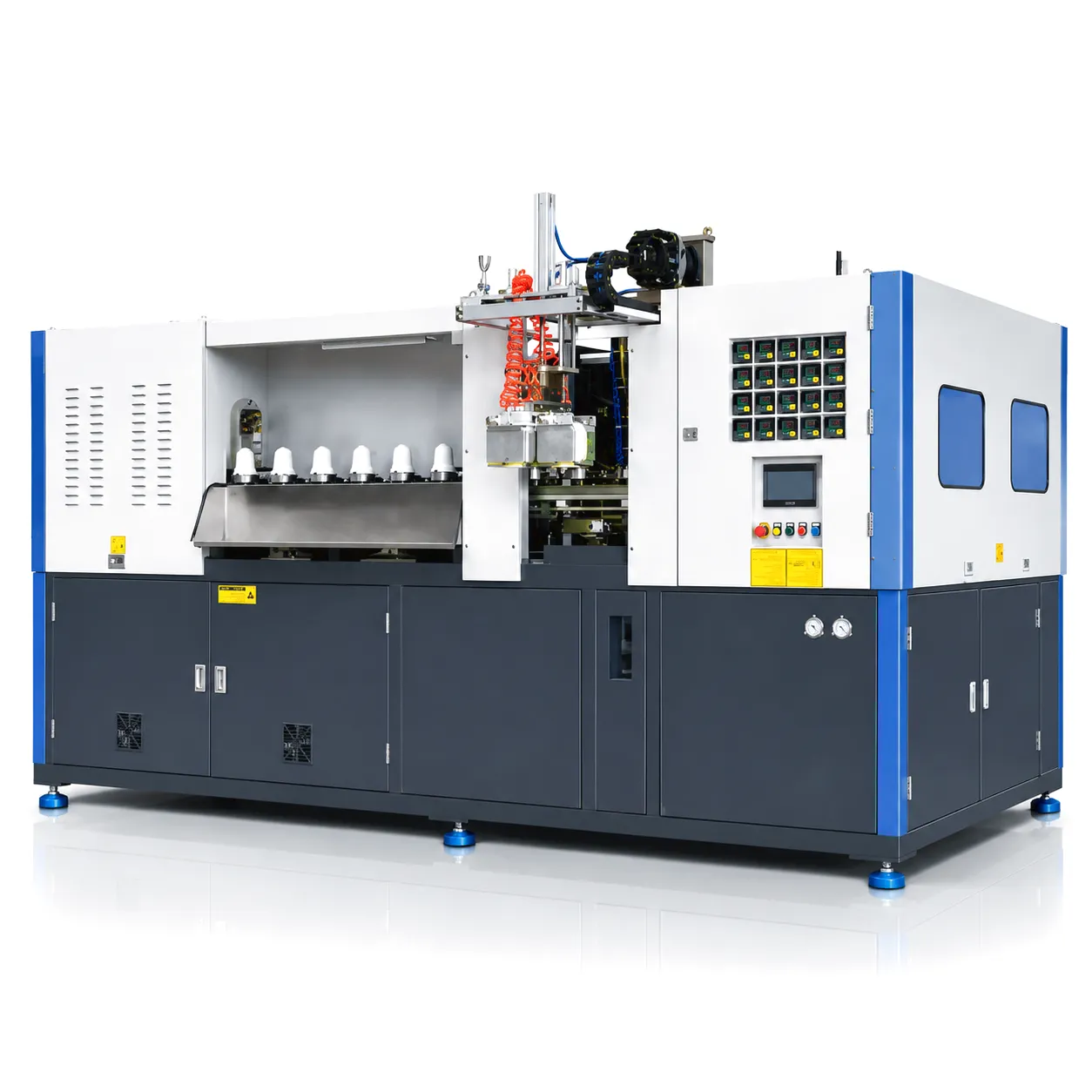
We had been running a one-step machine and struggled every time we switched bottle sizes. The two-step HGA approach completely changed that — we stock preforms and blow on demand. Setup time dropped from half a day to under 45 minutes.
The custom mould service was the deciding factor. We had a complex hexagonal bottle that three other machine suppliers said was impossible to blow consistently. The team redesigned the tooling and we have been running it at commercial volumes for over eight months with excellent wall uniformity.
Very impressed with the technical support during commissioning. The team understood our product spec from the first call and delivered a machine ready to run immediately. Energy consumption is noticeably lower than the previous line we operated.
Related Injection Blow Moulding Equipment
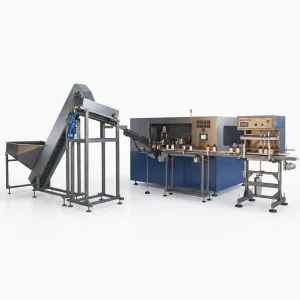
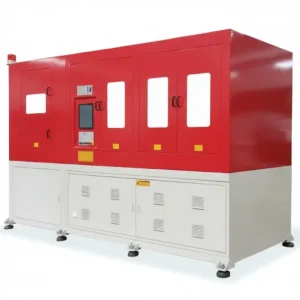
Alongside two-step stretch blow moulding, we also supply injection blow moulding (IBM) machines for PP, PE, and PET applications where a fully integrated one-step platform is preferred. Two proven machine platforms in this range include direct replacements for legacy Uniloy equipment — a common requirement for UK converters upgrading aging lines:
Replacement of Uniloy UIB 120 Injection Blow Moulding Machine — ZQ80
A modern, high-performance IBM machine engineered as a direct mechanical drop-in for facilities running the Uniloy UIB 120 platform. Suitable for producing precision PP or PE containers where the one-step process is preferred for dimensional accuracy and neck finish quality.
Replacement of Uniloy UIB 90 Injection Blow Moulding Machine — ZQ60
Designed to replace the UIB 90 series, the ZQ60 provides an updated control system, lower energy consumption, and improved clamp force regulation — making it a practical and cost-effective upgrade for UK IBM operators currently maintaining ageing Uniloy machinery.
Frequently Asked Questions
Questions we hear most often from UK packaging manufacturers evaluating two-step blow moulding machines.
Ready to Discuss Your Blow Moulding Project?
Send us your container drawing or specification and we will come back with a model recommendation, mould feasibility review, and full DDP price to your UK facility — usually within 48 hours.