Walk into any high-volume packaging facility — from a beverage filler in Sheffield to a personal-care bottler outside Birmingham — and the argument is almost always the same: linear or rotary? Both machine architectures extrude or inject polymer, form a parison or preform, and blow it into a finished container. Yet the way they sequence those steps differs enough to make one category definitively faster under certain conditions, and measurably less efficient under others.
This guide cuts through the marketing claims to deliver a data-grounded comparison. We look at raw cycle times, realistic annual output figures, tooling and energy costs, footprint requirements, and the types of container geometry each platform handles best. By the end, you will have a clear decision framework — not a generic checklist, but a concrete set of questions you can take into your next capital-equipment discussion.
The short answer: rotary machines achieve higher peak throughput for single-neck, uniform-geometry containers in continuous high-volume runs. Linear machines win on flexibility, rapid changeover, and total cost of ownership across a diverse SKU portfolio. The longer answer is why that matters for your specific production brief — and that is exactly what follows.
⚙
☰
How Each Machine Architecture Works
Understanding the mechanical logic behind each platform is the prerequisite for every throughput and cost comparison that follows.
Linear (Shuttle) Architecture
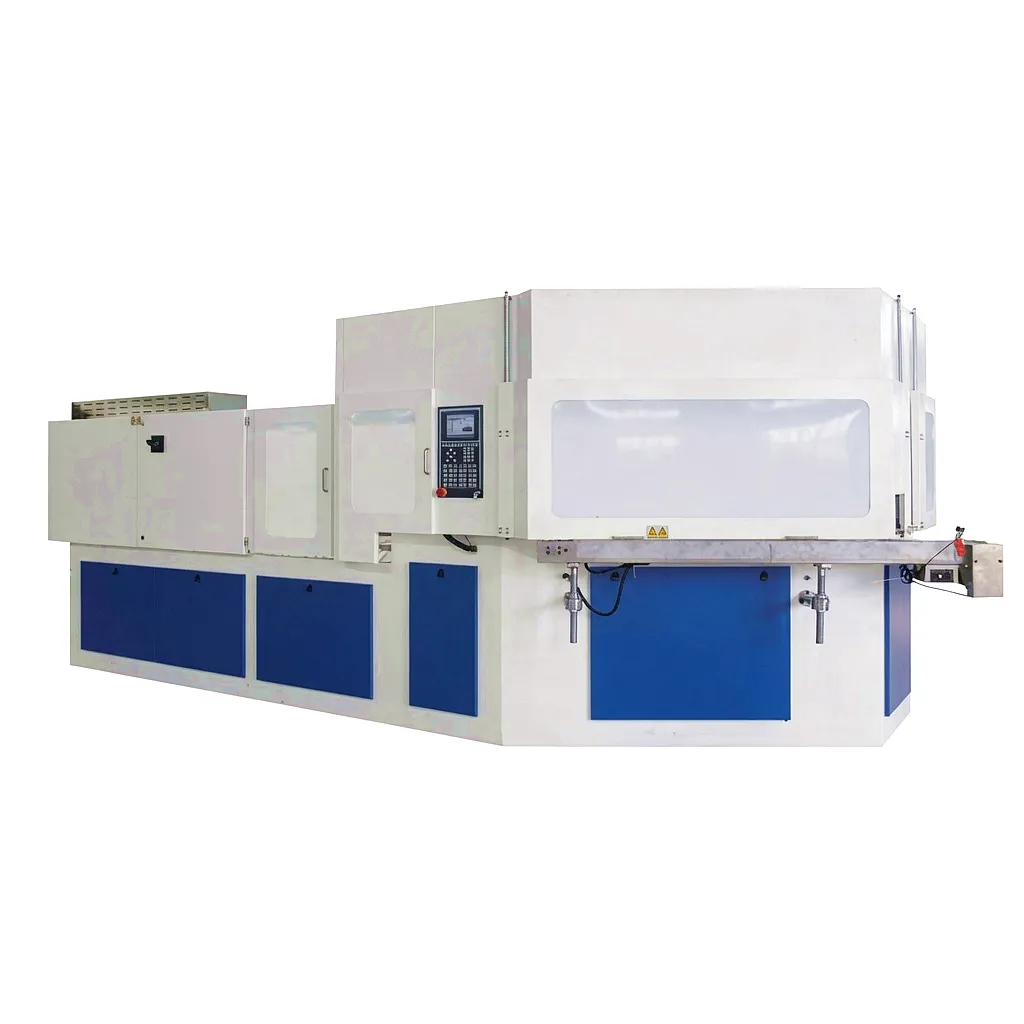
In a linear blow molding machine, the extrusion head deposits a molten parison in a straight, reciprocating motion. The mould platens travel horizontally — or vertically on certain single-stage injection-blow configurations — clamping around the parison before the blow pin descends and inflates the container. Once the part cools and the mould opens, the platens retract along the same linear axis, and the cycle restarts.
This architecture is inherently modular. A manufacturer can run a two-cavity tool one week and swap in a six-cavity tool the following week with relatively modest downtime. The linear layout also keeps the parison drop distance consistent, which is critical for containers with complex handles, off-centre necks, or asymmetric body profiles. UK packaging lines in Leicester and Stoke-on-Trent handling seasonal HDPE container ranges frequently cite linear machines as their preferred platform precisely because of this changeover speed.
Flexible cavity count
Complex geometries
Rotary (Wheel) Architecture
A rotary blow molding machine mounts multiple mould sets around a central rotating wheel or carousel. As the wheel turns continuously, each station passes beneath the extrusion head to receive a parison, then travels through a blow zone where the bottle is inflated, then through a cooling arc, and finally past a deflashing and ejection station before returning to the extrusion point. Because all phases happen simultaneously on different stations, the machine never truly pauses — it produces finished containers in a continuous, overlapping cadence.
The engineering elegance is clear: a wheel carrying sixteen stations running a 6-second station cycle yields an effective output rate of roughly 9,600 bottles per hour for a single-cavity tool. Scale that to multi-cavity moulds and the numbers become compelling for a beverage bottler in Manchester or a dairy processor in Yorkshire committed to a single container format for years at a stretch. The trade-off is that retooling the wheel for a different neck finish or body diameter is a full production stop measured in days rather than hours.
High station count
Sustained high volume
Throughput: The Numbers Behind the Claims
Raw speed statistics mean little without knowing the production conditions. Here is how the two architectures compare across multiple output metrics.
| Performance Metric | Linear Machine | Rotary Machine | Advantage |
|---|---|---|---|
| Peak bottles/hour (500 ml, single-cavity) | 1,200 – 2,400 | 6,000 – 12,000 | Rotary ↑↑↑ |
| Effective cycle time per station | 3 – 8 s (full cycle) | 5 – 10 s (station arc) | Similar per station |
| Simultaneous active stations | 1 – 2 | 8 – 24 | Rotary ↑↑↑ |
| Mould changeover time | 45 min – 3 h | 6 – 24 h | Linear ↑↑↑ |
| Annual output (20-station rotary / 4-cavity linear, 500 ml) | ~40 – 60 million units | ~120 – 200 million units | Rotary ↑↑↑ |
| Machine footprint (floor area) | 8 – 25 m² | 30 – 120 m² | Linear ↑↑↑ |
| SKU variety per year (practical) | 10 – 60 SKUs | 1 – 6 SKUs | Linear ↑↑↑ |
What the table makes plain is that throughput comparisons are only meaningful when you specify the station count and run duration. A 20-station rotary machine with a 6-second arc cycle achieves a theoretical maximum of 12,000 bottles per hour — ten times what a twin-head linear machine with a 3-second clamp cycle can produce. But that figure assumes zero downtime, which rotary machines are more susceptible to because a single station failure can degrade quality across the entire wheel until the problem is isolated.
For UK contract manufacturers handling private-label volumes in the 20 to 80 million units per year range, the practical gap between the two architectures narrows considerably once changeover downtime is factored into OEE calculations. Sheffield-based converters running 12 to 15 SKU changes per month frequently report that a well-maintained four-head linear machine achieves a higher annual OEE percentage than a larger rotary machine with complex retooling requirements.
Energy Consumption and Cost Per Unit
With UK industrial electricity prices remaining elevated, energy consumption per bottle has become a primary procurement criterion for many operations directors.
Servo-driven linear machines with variable-speed drives on the extruder and hydraulic pump circuits typically land at the lower end of this range. Older toggle-clamp models with fixed-displacement pumps can exceed 40 kWh/1,000 units — a meaningful cost at UK grid prices near 25 – 30 p/kWh.
Because the rotary wheel runs continuously without the dead time associated with platen retraction and repositioning, energy consumption per unit is considerably lower at full-speed operation. The continuous extrusion head maintains a more stable melt temperature, reducing the peak heating demands that drive energy spikes in reciprocating systems.
£3.20 – £5.80
£1.40 – £2.90
These cost-per-unit figures assume the rotary machine is running at or above 85% utilisation continuously. The moment utilisation drops below that threshold — because the line is down for retooling, or because demand for a particular SKU is seasonal — the economics shift toward linear. UK beverage converters in Bristol and Nottingham that serve multiple retail grocery chains have confirmed this in published operational reviews: the rotary machine earns its keep only when it can be kept turning.
A linear machine’s higher per-unit cost at scale is partly offset by lower capital expenditure (typically 30 to 50% lower machine purchase price), lower tooling cost (a set of linear blow moulds averages £8,000 – £20,000 versus £25,000 – £80,000 for a full rotary wheel tooling set), and significantly lower risk of a single mechanical failure cascading into a complete line stoppage.
Container Geometry, Materials, and Process Compatibility
Neither architecture is universally superior in what it can physically produce. The geometry of the container and the polymer being processed both influence which platform is appropriate.
What Linear Machines Handle Best
- ✓Handled containers (e.g., jerricans, automotive fluid bottles) where a separate handle pinch-off is required — the linear parison drop allows clean handle formation
- ✓Large containers over 5 litres, where gravitational parison sag is easier to compensate with a short vertical drop path and parison programming
- ✓Complex multi-layer co-extrusion structures (HDPE/EVOH/HDPE barrier bottles) that require multiple extruder heads and precise layer-thickness control
- ✓Asymmetric body profiles, offset neck positions, and oblong cross-sections common in pharmaceutical and agrochemical packaging
- ✓Low-density polyethylene (LDPE), polypropylene (PP), and PVC materials that benefit from the controlled residence-time flexibility the linear process offers
What Rotary Machines Handle Best
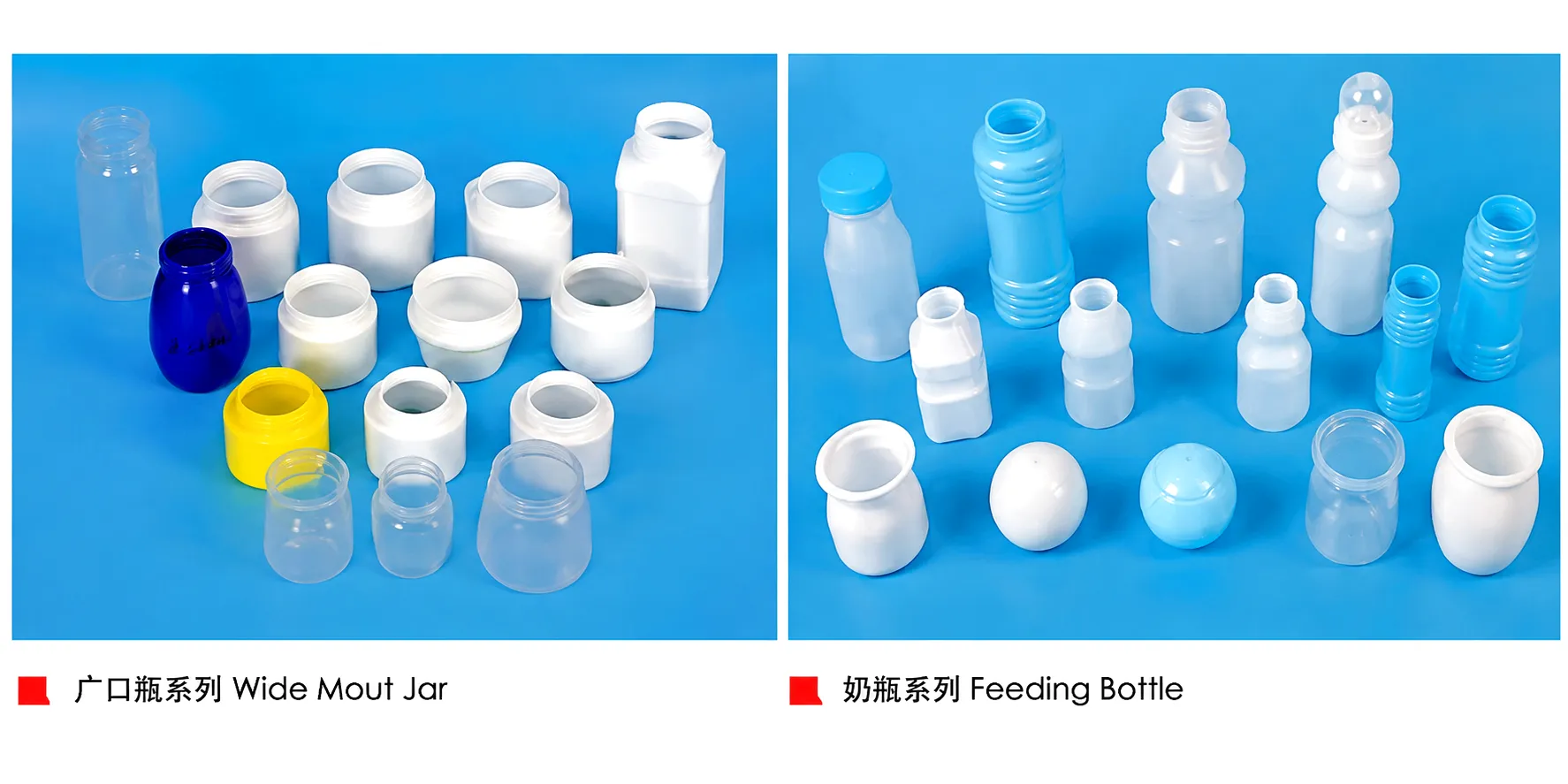
- ✓Round or near-round cross-section bottles under 5 litres — the geometry where parison stretching is most uniform across all wheel stations simultaneously
- ✓Beverage, dairy, and personal-care containers in HDPE or PP where a single neck finish is maintained across extremely high annual volumes
- ✓Applications demanding consistent, repeatable wall-thickness distribution when the container geometry permits uniform radial blow ratio
- ✓Operations with dedicated filling lines that run a single SKU for extended campaigns of six months or longer — common in UK contract dairy filling
- ✓Facilities targeting the lowest possible per-unit material cost, since rotary’s parison wall-thickness programming achieves tighter weight tolerance at high speed
| Polymer | Linear | Rotary | Notes |
|---|---|---|---|
| HDPE | ✓ Excellent | ✓ Excellent | Primary material for both; rotary more efficient at scale |
| PP (Polypropylene) | ✓ Good | ✓ Good | Requires careful melt-temperature control; 220 – 250°C range |
| LDPE | ✓ Excellent | ~ Moderate | LDPE sag characteristics suit linear’s shorter parison path |
| PVC | ✓ Good | − Not recommended | PVC thermal degradation risk increases on long-residence rotary circuits |
| HDPE/EVOH/HDPE (multilayer) | ✓ Excellent | − Very limited | Co-extrusion head integration favours linear station layout |
| Recycled HDPE (rHDPE) | ✓ Good | ~ Moderate | rHDPE viscosity variance easier to compensate with linear parison programming |
Operational Flexibility and OEE in UK Production Environments
Overall Equipment Effectiveness (OEE) tells a more complete story than raw cycle speed, and it is where UK production contexts reveal the most nuanced differences.
UK packaging manufacturers face a distinct set of pressures that influence how each machine type performs in practice. Retail grocery consolidation means that a converter serving a major supermarket chain’s own-label range may be expected to accommodate promotional packaging changes, seasonal volume swings, and new-product introductions with minimal lead time. For a facility based in the Midlands or the North West, where multi-client contract manufacturing is common, the ability to switch between container formats rapidly is not a marketing benefit — it is a contractual requirement.
A well-maintained four-head linear machine with experienced operators typically achieves 78 – 88% OEE in a high-SKU environment. The relatively short changeover window means availability losses are contained. When a single platen or blow-pin assembly develops a fault, the operator can often isolate that head and continue production at reduced capacity — a resilience characteristic rotary machines cannot match.
Performance losses in linear machines tend to concentrate around parison programming — if the head’s accumulator isn’t calibrated correctly after a material lot change, wall-thickness variation increases scrap rates. Modern digital parison controllers with 100-point programming resolve this, but older equipment on UK shop floors may rely on less precise analogue controls.
A rotary machine committed to a single product running on a dedicated filling line can achieve 90 – 96% OEE in steady state — a figure linear machines cannot sustain at equivalent volume. The key variable is the length of production runs. When campaigns exceed three weeks without a mould change, the rotary machine’s availability and performance factors both remain high because no retooling disruption occurs.
Quality losses on rotary machines often stem from thermal variation across the wheel arc. If the blow zone temperature profile drifts, stations at the warm end of the arc begin producing containers with thinner base sections. Infrared pyrometry on each station combined with closed-loop temperature control has largely resolved this on machines manufactured since 2015, but earlier installations still run manual temperature audits between shifts.
Rotary: ~62% OEE
Rotary: ~93% OEE
Capital Investment, Payback Period, and Total Cost of Ownership
Purchase price is one data point in a decision that spans five to fifteen years of operation. Here is how the investment case unfolds for each architecture.
| Cost Category | Linear | Rotary |
|---|---|---|
| Machine purchase price (new, mid-range) | £80,000 – £250,000 | £220,000 – £900,000 |
| First tooling set (per product) | £8,000 – £20,000 | £25,000 – £80,000 |
| Annual energy cost (3-shift, 250 days) | £18,000 – £55,000 | £45,000 – £140,000 |
| Annual maintenance (parts + labour) | £6,000 – £18,000 | £14,000 – £45,000 |
| Operator skill level required | Intermediate | Advanced / specialist |
| Typical payback period (full-utilisation) | 2.5 – 4 years | 3 – 6 years |
For a manufacturer considering its first blow molding investment — or a company diversifying into blow molding from injection moulding — the linear machine’s lower entry cost and faster payback represent a meaningful risk reduction. For a large-scale dairy or beverage producer in Yorkshire or the East Midlands with long-term supply agreements and consistent volume commitments, the rotary machine’s longer payback can be justified by the dramatically lower per-unit cost at high utilisation.
It is also worth factoring in the resale market. Used linear blow moulding machines retain strong second-hand values within the UK because their modular nature makes them suitable for a wide range of buyers. Rotary machines are more specialised, and their used market is thinner — a meaningful consideration for businesses anticipating strategic shifts over a 10-year horizon.
Decision Framework: Which Machine Fits Your Operation?
Rather than a single verdict, use these decision gates to map your production requirements to the right architecture.
Industry Application Scenarios Across UK Sectors
Beverage & Dairy Bottling (Rotary Preferred)
HDPE milk bottles, flavoured-water containers, and juice bottles in the 500 ml to 2-litre range are the rotary machine’s home territory. Yorkshire dairy processors running dedicated 2-litre milk bottle lines achieve output rates that make a rotary wheel the only economically viable platform. Uniform round bodies, consistent neck finishes, and multi-year campaign lengths are the signature conditions.
Automotive Fluid Containers — Birmingham & Coventry (Linear Preferred)
Windscreen wash containers, brake fluid bottles, oil containers with integral pouring handles, and DEF jerricans all share geometry characteristics that demand linear processing. West Midlands automotive supply-chain converters produce dozens of SKUs annually, with different handle positions, barrier layers, and closure neck standards — an environment where a six-head linear machine with quick-change tooling delivers tangible commercial advantage.
Agrochemical & Industrial Chemicals — Rural Lincolnshire (Linear Preferred)
5-litre and 10-litre HDPE/EVOH multilayer barrier containers for pesticide concentrates, fertiliser liquids, and agricultural adjuvants are exclusively produced on linear machines. The co-extrusion requirement for a chemical-resistant inner layer (HDPE) and an EVOH barrier mid-layer physically cannot be replicated on a conventional rotary wheel, and the handled geometry confirms the linear choice.
Personal Care & Household Products — Manchester & Leeds (Both)
Shampoo bottles, conditioner containers, and household cleaning bottles occupy a middle ground. Large-volume own-label shampoo runs for national supermarkets suit a rotary machine when a single 250 ml round format dominates the order book. The same converter switching between premium shaped-bottle personal-care ranges for boutique brands will find a four-head linear machine more commercially practical across the same twelve-month period.
Where the Technology Is Heading
The throughput gap between linear and rotary machines has narrowed over the past decade, driven by advances in servo drive technology, digital parison control, and predictive maintenance systems. Electric all-servo linear machines now achieve cycle times previously only possible on dedicated rotary equipment, while simultaneously reducing energy consumption by 20 to 35% compared to hydraulic equivalents. For smaller UK manufacturers who could never justify a rotary machine, these advances have opened up throughput tiers that were previously inaccessible.
The shift from hydraulic to fully servo-electric actuation on linear machines eliminates hydraulic oil contamination risk, reduces heat rejection, and enables precise position repeatability at the sub-millimetre level. For pharmaceutical and food-contact packaging producers in the UK operating under strict hygiene standards, this is increasingly a regulatory driver rather than a commercial one.
Modern rotary machines now integrate camera-based inspection at the ejection station, capable of detecting wall-thickness variation, base-pinch defects, and neck-finish flashes at full production speed. This closes the quality-monitoring gap that historically gave linear machines an advantage — operators on a linear line can visually inspect deflashed parts continuously, something not practical on a high-speed rotary wheel without automation.
UK sustainability regulations and Extended Producer Responsibility obligations are pushing converters toward higher recycled-content percentages. Linear machines currently handle rHDPE with variable viscosity more gracefully, because parison programming can be adjusted station-by-station to compensate for melt-flow inconsistencies. Rotary OEMs are addressing this through advanced adaptive control systems, but the linear machine retains a practical advantage with challenging recycled materials today.
The Throughput Answer — and Why Context Is Everything
Rotary blow molding machines produce higher peak throughput. That is a fact of engineering geometry — multiple simultaneous stations running continuously will always outpace a reciprocating linear system at equivalent station cycle time. For a UK beverage or dairy producer with a committed volume base above 80 million units per year and minimal SKU variation, the rotary machine is the correct industrial tool.
But throughput is a rate, not a result. What lands on a pallet and ships to a customer is the product of throughput and utilisation and quality yield. When all three are calculated together — accounting for changeover losses, energy costs, tooling investment, and scrap rates — the linear machine wins or draws in the majority of UK production environments that operate with genuine commercial complexity. For most UK packaging manufacturers running between 10 and 80 million units annually across a varied product range, the linear machine’s blended economics and operational resilience make it the safer, more profitable long-term platform.
Choose rotary for volume above 80 M units/year, uniform round containers, single-SKU dedicated lines
Choose linear for multi-SKU environments, handled containers, multilayer structures, constrained floor space, or first investments
In the 20 – 80 M unit/year range, OEE and changeover frequency determine the better choice — calculate both before committing
edit by gzl