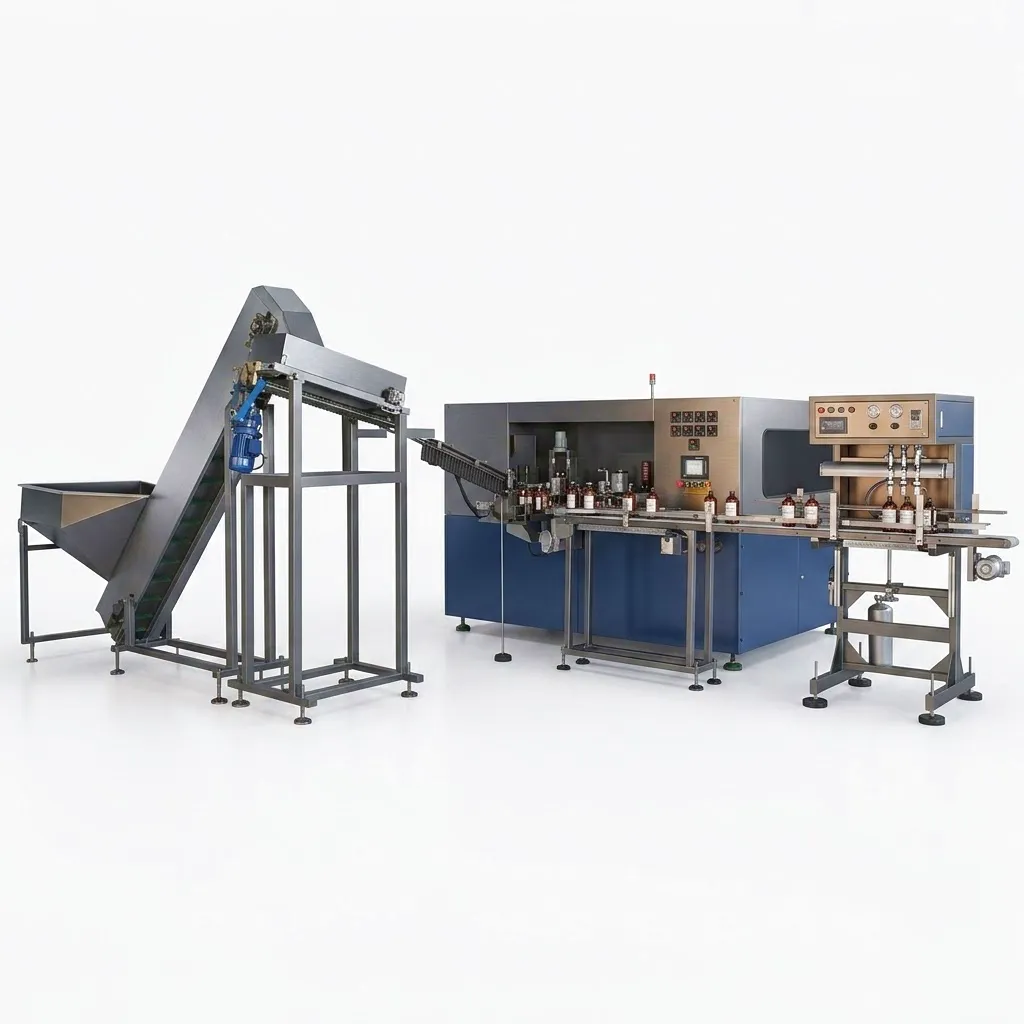
Описание
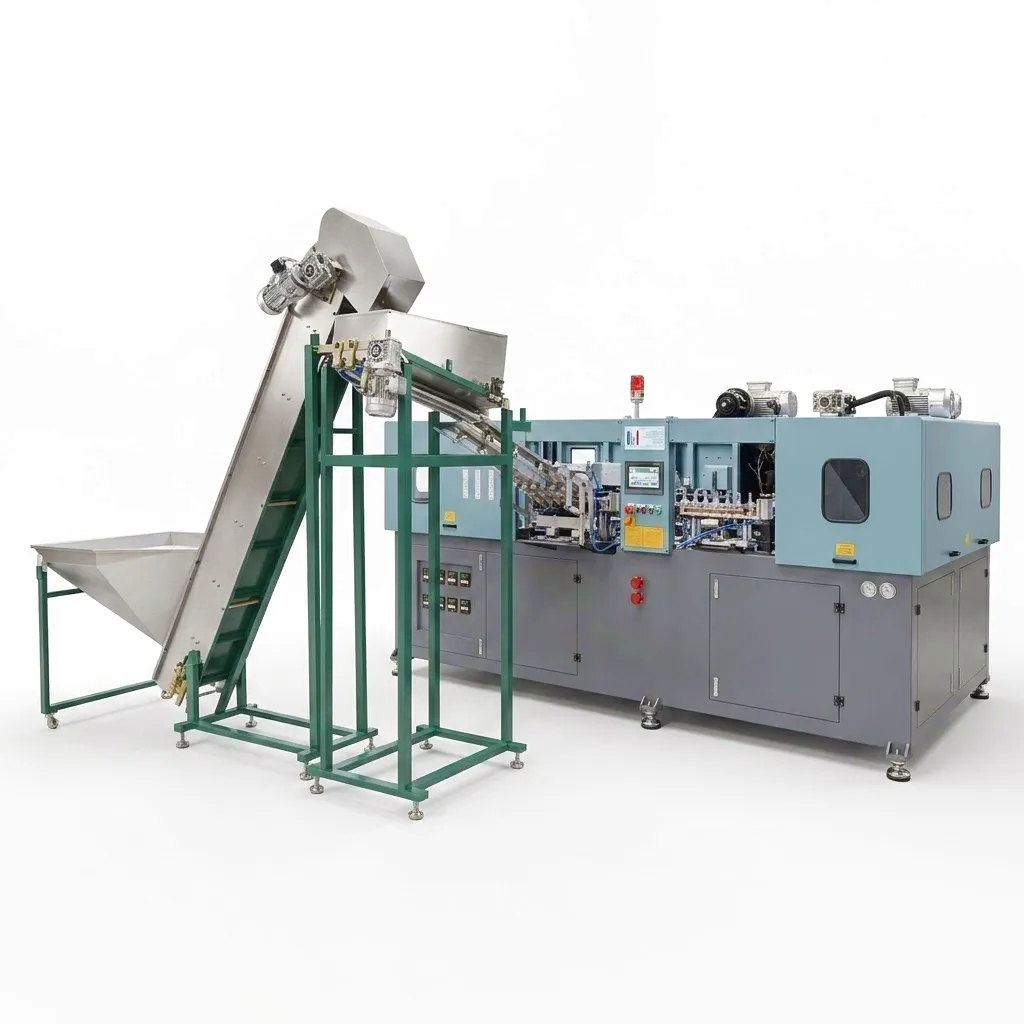
Request a Quote
Technology Overview
What Makes a Two-Step Blow Molding Machine Different?
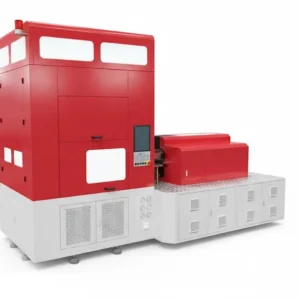
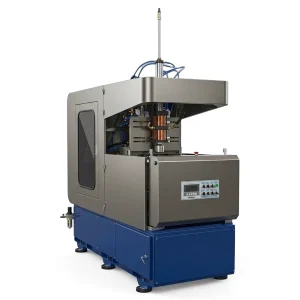
The defining characteristic of the two-step blow molding machine — also called reheat stretch blow moulding (RSBM) — is the complete separation of preform production from bottle blowing. Rather than injecting and blowing within one integrated cycle, the machine accepts externally manufactured PET or PP preforms, conditions them through a multi-zone infrared heating oven, and then stretches and inflates them inside precision moulds using high-pressure air. The two-stage approach gives packaging engineers a level of control over wall distribution, clarity, and biaxial orientation that inline single-stage machines simply cannot match at comparable throughput rates.
For UK mineral water bottlers, carbonated soft drink producers, juice and dairy co-packers, and pharmaceutical liquid packagers operating at volume, the two-step process is the standard production model. Preforms can be sourced from any compatible supplier — including the growing range of recycled-content rPET preforms — and changed between campaigns without halting the blow moulding line. The result is a factory floor operation that is simultaneously more productive, more flexible, and more economical per bottle produced than any alternative.
This Water and Beverage Bottle Series covers a deliberately broad container range — from compact 500 ml single-serve formats on the HGA.ES-2C100 right through to 22,000 ml large-format water cooler vessels on the HGA.JS-2C366 — making it one of the most versatile RSBM families available to the UK and European packaging market.
The RSBM Process
Preform Loading
Externally supplied PET or PP preforms are fed into the machine via an automatic conveying and sorting system — enabling flexible preform sourcing from any compatible third-party manufacturer.
Infrared Heating
Multi-zone infrared ovens raise preform temperature to the resin-specific orientation window (typically 90°C–120°C) while rotating mandrels ensure uniform radial heat distribution — the foundation of consistent wall thickness.
Stretch-Blow Moulding
A stretch rod extends axially into each preform as high-pressure air (26–35 kg/cm²) expands it radially against the mould wall. Biaxial orientation aligns polymer chains, producing bottles with excellent clarity, burst strength, and barrier performance.
Cooling & Ejection
Mould cooling water circuits (8–12°C, 5–6 kg/cm²) rapidly set the bottle geometry. Finished containers eject onto the output conveyor, ready for labelling, filling, or capping downstream.
Why UK Bottlers Choose This Series
Built for High-Volume British & European Production
Peak Throughput up to 9,200 bph
Eight-cavity models achieve 9,200 bottles per hour in sustained production — delivering the output density required to run high-SKU beverage lines around the clock without capital investment in multiple machines.
Flexible Preform Sourcing
Because preform production is entirely separate from bottle blowing, operators can switch preform suppliers, grades, or rPET content without any mechanical change to the blow moulding machine — a critical commercial advantage in volatile resin markets.
Broad Format Coverage
A single series handles containers from 500 ml compact bottles through 5-litre sports/cooler formats up to 22-litre large-volume vessels — covering every common UK beverage and industrial liquid packaging segment.
Zoned Infrared Heating Efficiency
Normal operating heating power ranges from 8 kW on entry models to 45 kW on large-format units — substantially below the installed maximum, keeping energy running costs proportionate to actual throughput during partial-load shifts.
Heavy-Duty Structural Integrity
Machine weights from 2,000 kg on compact 2-cavity models to 8,000 kg on 8-cavity configurations provide the mass and rigidity needed to maintain dimensional accuracy across extended production runs at full blowing pressure.
PET, PP & rPET Compatible
The heating system accommodates standard PET, polypropylene, and recycled-content rPET preforms, allowing UK producers to adapt to evolving sustainability commitments and Extended Producer Responsibility (EPR) targets without equipment replacement.
Materials, Applications & Target Sectors
What Bottles Does This Machine Produce?
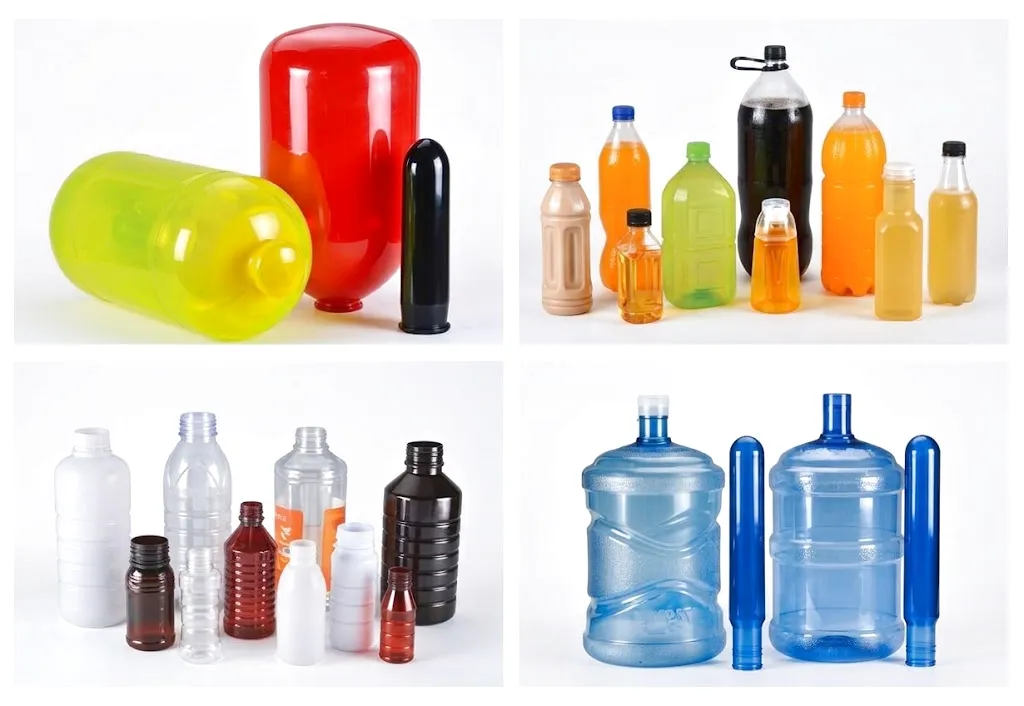
The Water and Beverage Bottle Series two-step blow molding machine was developed specifically for the multi-pitch, multi-cavity requirements of mineral water, spring water, carbonated soft drink, juice, flavoured dairy, and pharmaceutical syrup bottle production. The designation “multi-pitch, multi-cavity” in the original engineering specification refers to the machine’s ability to handle preforms at variable pitch spacings across the heating and blowing stations — a design feature that reduces idle station time and directly contributes to the series’ high theoretical output figures. Bottle formats range from narrow-neck 500 ml water bottles with 38 mm neck diameters on 6-cavity models, through standard 1-litre and 1.5-litre household formats, up to wide-mouth 22-litre cooler vessels on the large-format HGA.JS-2C366.
On the materials side, PET remains the dominant resin for the water and beverage segment because of its optical clarity, carbon dioxide barrier performance for carbonated drinks, and the extensive third-party preform supply network available across the United Kingdom. Polypropylene is the preferred choice for pharmaceutical liquid packaging — oral syrups, antiseptic solutions, eye-drop bottles — where chemical resistance and sterilisation compatibility take priority over CO₂ barrier. Both resins are processed from externally supplied preforms in the two-step workflow, and the infrared heating system is adjustable per resin type without hardware modification. UK producers sourcing rPET preforms as part of sustainability or EPR compliance programmes will find the two-step process particularly accommodating, as heating parameters can be profiled per preform batch independently of the blowing tooling.
CSD / Carbonated Drinks
Juice & Smoothies
Flavoured Dairy
Pharmaceutical Liquids
Water Cooler Vessels (5–22 L)
Household Chemicals
rPET Sustainability Lines
Full Parameter Reference
Technical Specifications — HGA & HGA.JS Series
bph = bottles per hour. Specifications subject to change. Contact our engineering team for UK-specific configuration advice and custom requirements.
Manufacturing & Custom Engineering
Bespoke Solutions for UK Bottling Lines
Our manufacturing facility operates dedicated CNC machining centres, precision assembly workshops, and a full-scale pre-shipment testing hall where every two-step blow molding machine undergoes validated dry-run cycles before dispatch. The engineering team has experience across mineral water, carbonated beverage, pharmaceutical, dairy, and household chemical bottle formats — real application depth that shows in how we specify and configure equipment for individual customer requirements.
Product customisation is a genuine engineering capability, not a marketing claim. We regularly deliver machines with non-standard cavity counts, modified pitch spacings to match existing preform conveying systems, bespoke mould-open strokes for unusual container geometries, and electrical control panels configured for UK 50 Hz three-phase supply at 230 V or 415 V. Ancillary equipment — integrated air compressors, industrial chillers, automated preform loaders, and downstream conveying systems — can be included in the same supply scope, allowing turnkey blow moulding line delivery and commissioning at your production site anywhere across England, Scotland, and Wales.
📦 Standard & Custom Cavity Counts
2, 4, 6, or 8 cavities from the catalogue range; non-standard counts engineered on request. Higher cavity counts reduce cost-per-bottle on high-volume lines.
🏭 UK 50 Hz Electrical Configuration
Control panels configured to British electrical standards — 50 Hz, 230 V single phase and 415 V three-phase — with English-language HMI interfaces and UK-compatible safety interlocks.
🔧 On-Site Commissioning across the UK
Our commissioning engineers are available for installation, operator training, and production validation at UK factory sites — from the Midlands and Northern England through to Scotland.
📈 Spare Parts Fast-Shipped to UK
Recommended 12-month spares packs dispatched with each machine. Critical consumables — IR lamps, seals, clamping wear parts — held in inventory for fast UK delivery.
Customer Success
How a Yorkshire Water Bottler Scaled Output by 140%
AquaSpring Natural Waters Ltd. — Harrogate, North Yorkshire
Industry: Natural Spring Water Bottling | Region: Northern England
AquaSpring Natural Waters, a family-owned spring water producer based in Harrogate, had been operating a single-stage inline blow moulding machine for their 500 ml and 750 ml still water formats. By mid-2024, seasonal demand peaks from retail and foodservice accounts were consistently outpacing production capacity, capping output at around 3,000 bottles per hour and forcing the business to decline new volume orders from two national retail buyers. The existing equipment also locked them into one preform supplier, creating exposure when global PET resin prices rose sharply in Q1 2024.
After a two-day technical consultation with our application engineers — covering container format requirements, floor space constraints, UK 415 V electrical supply, and integration with their existing labelling and filling line — AquaSpring selected the HGA.ES-6C76 two-step blow molding machine with a 6-cavity tooling set optimised for the 500 ml format. Installation was completed over a three-day planned shutdown, with our commissioning engineer on-site throughout. The first production week validated a consistent throughput of 7,200 bottles per hour — a 140% improvement over previous peak output.
The two-step process immediately demonstrated its commercial flexibility: within six weeks of commissioning, AquaSpring introduced a 1-litre sports-cap variant using a different preform grade from a second supplier, switching between formats with a straightforward mould change and no modification to the blow moulding machine. By early 2025 they had secured both retail accounts previously declined on capacity grounds. Capital payback was achieved within 18 months, attributed to reduced labour cost per unit, lower energy consumption per bottle compared to the old single-stage machine, and incremental revenue from the new retail contracts.
Customer Testimonials
“We have been running the HGA.ES-4C100 on our 750 ml still water line for over a year without a single unplanned stoppage. Switching to two-step blowing gave us the freedom to change preform suppliers when PET costs spiked — something our old inline machine simply couldn’t allow. The machine paid for itself faster than we projected.”
“The technical support after delivery was what really stood out. When we had a question about heating zone profiling during our first month, the engineers sent a detailed parameter adjustment guide the same afternoon. The machine handles our pharmaceutical syrup bottles with consistent wall thickness across every cavity — we’ve had zero rejects due to machine variability since commissioning.”
“We specified the HGA.JS-2C200 for our 5-litre water cooler format. Competitors’ machinery at this container size tends to be unstable at full blowing pressure — we had bad experiences previously. This machine is solid, the bottles are dimensionally consistent, and the commissioning team was professional throughout. We are already planning a second unit for the Scottish Highland spring water range we are launching next year.”
Related Equipment
Injection Blow Molding Machine Alternatives
For UK pharmaceutical, cosmetic, or specialty packaging operations where injection blow moulding (IBM) remains the preferred process — particularly for narrow-neck, multi-layer, or precision-volume containers — we also supply a proven IBM range fully compatible with existing legacy tooling.
Frequently Asked Questions
Questions from UK Bottling & Packaging Buyers
Get in Touch Today
Ready to Upgrade Your UK Bottling Line?
Share your bottle format, required output rate, and UK site location. Our engineers will recommend the right model, prepare a full quotation, and manage delivery and commissioning from factory to production-ready machine at your facility.
edit by gzl