Описание
What Is a Two-Step Semi-Automatic Blow Molding Machine?
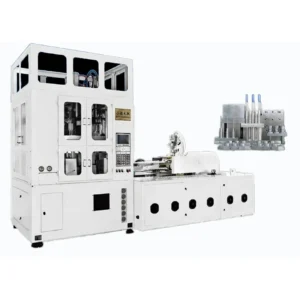
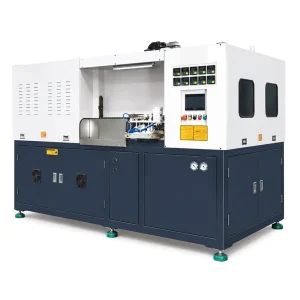
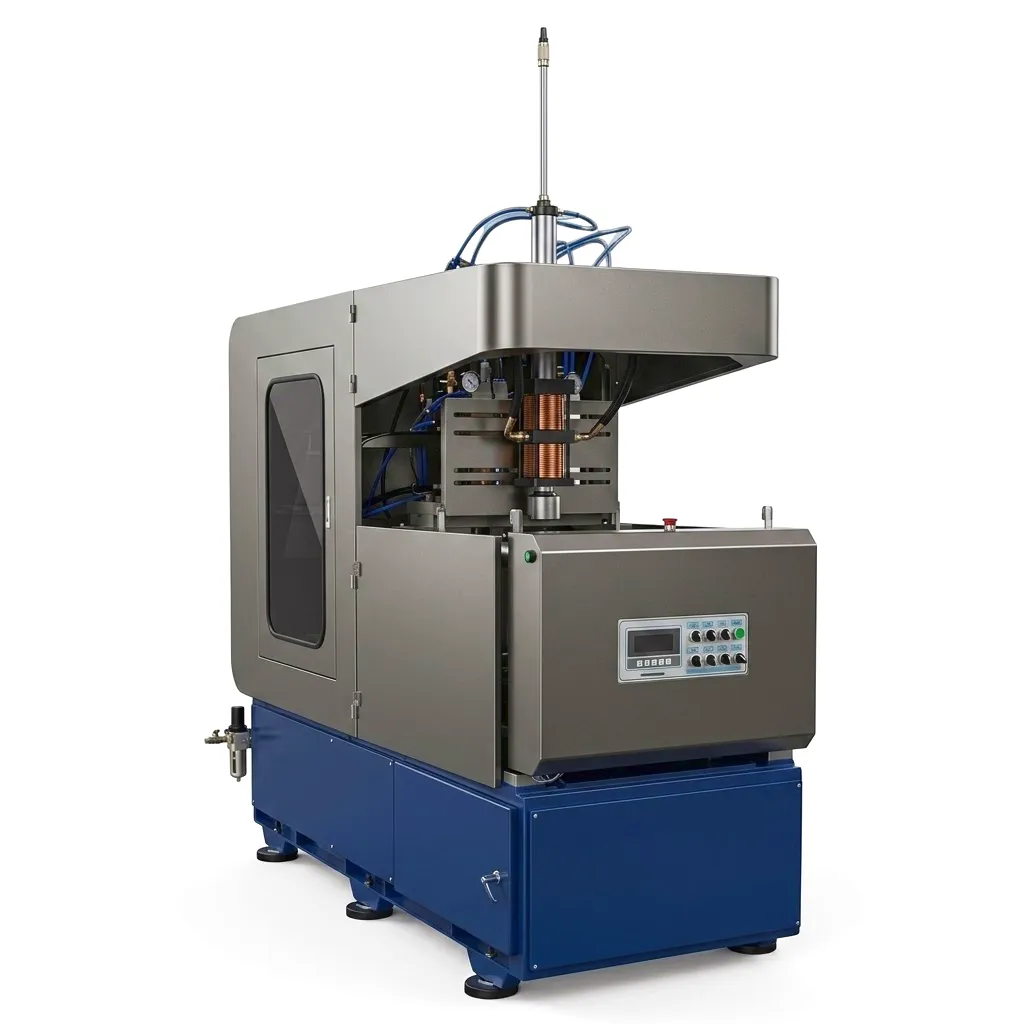
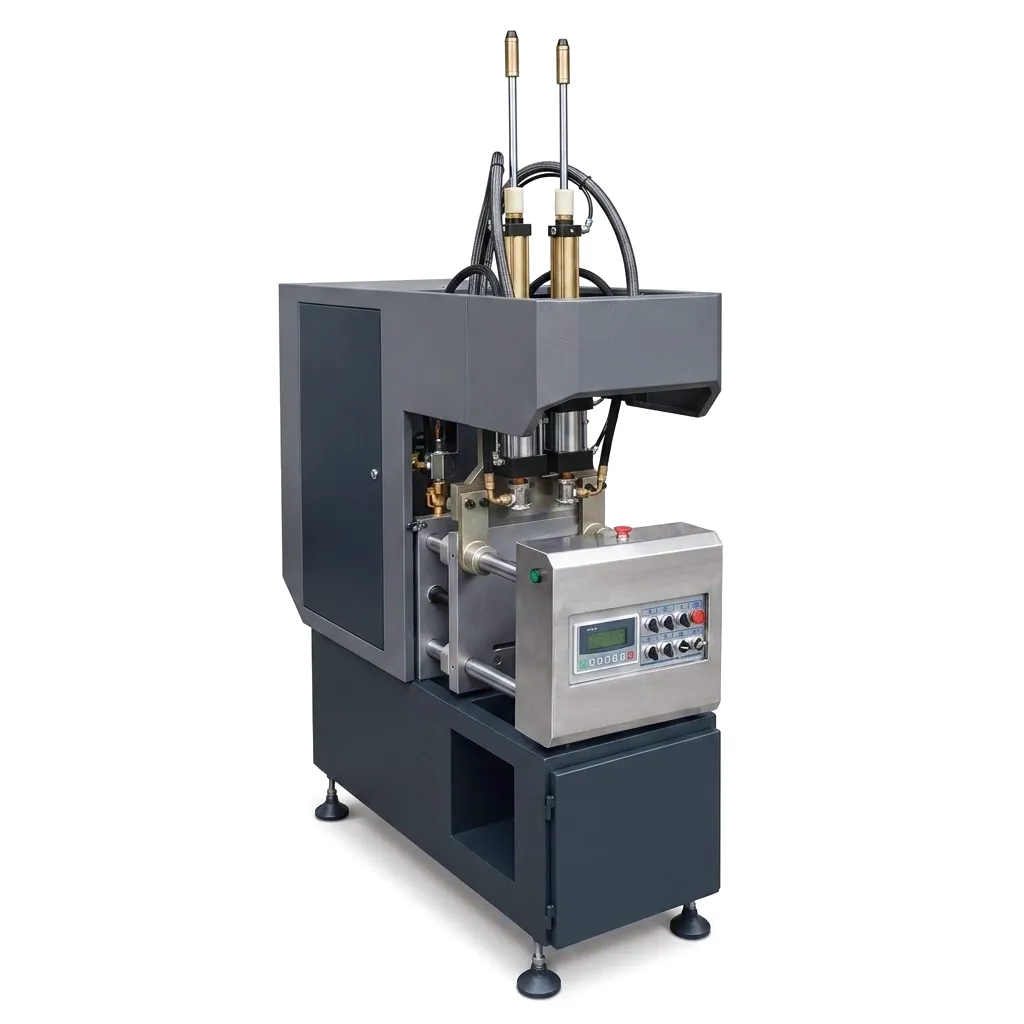
The HGS Series semi-automatic blow molding machine operates on a two-step stretch blow molding (SBM) process. Unlike one-step injection blow molding — where the preform and bottle are produced in a single machine cycle — the two-step method separates production into two distinct phases. An independent injection moulding machine first produces PET preforms to precise dimensional standards. Those preforms are then loaded into the HGS semi-automatic blow molding machine, reheated using infrared technology, mechanically stretched along the axial direction, and simultaneously blown outward with high-pressure air at up to 3.0 MPA to achieve the final bottle geometry. This separation of processes gives production managers far greater flexibility: preforms can be sourced or produced in bulk, stored, and blown on demand — a major operational advantage for UK contract packers managing mixed SKU runs.
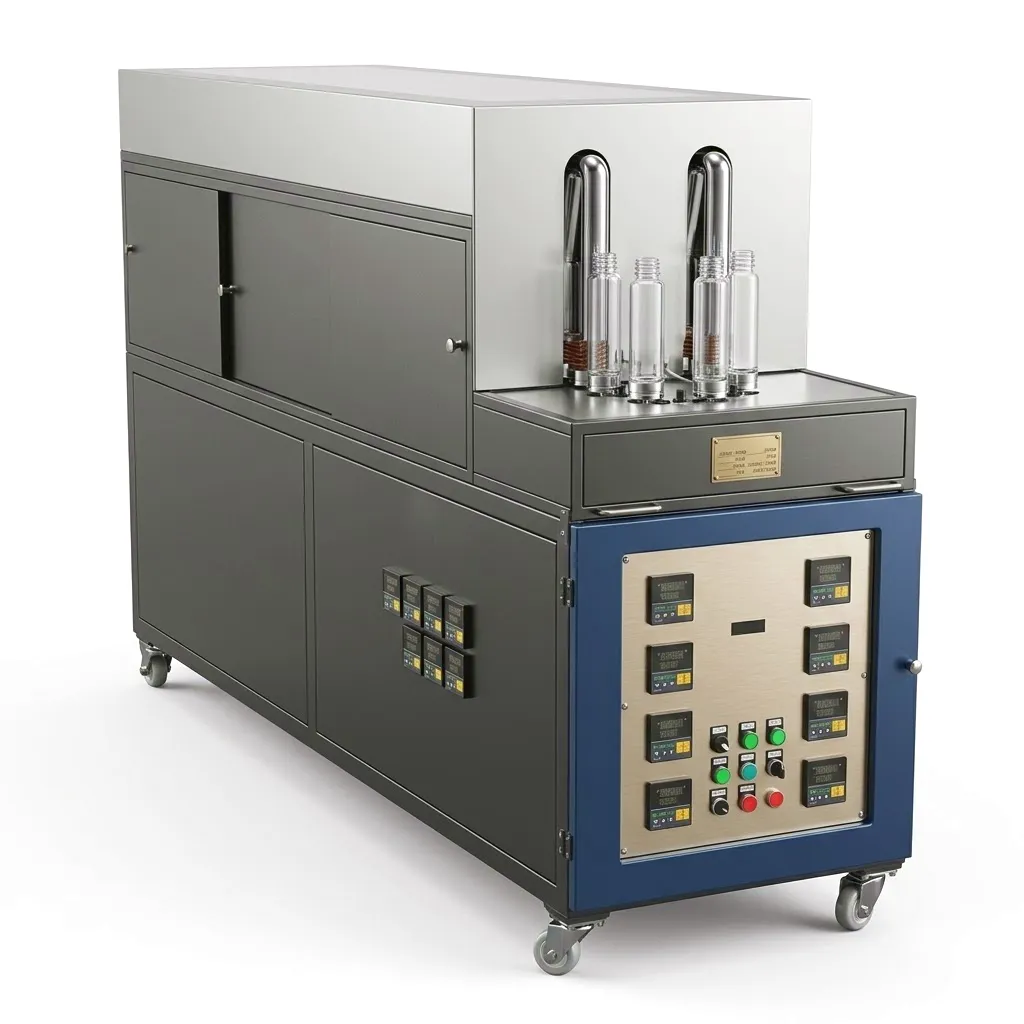
Across the HGS product range, two locking mechanisms are available — pneumatic-hydraulic linkage or cylinder-based clamping — so buyers can match the machine configuration to their existing infrastructure and bottle complexity. The HGS-200B variant is further engineered for hot-fill production, rated to withstand continuous operation at up to 88–95°C, making it particularly suited to tea beverages, isotonic drinks, and juice products that require Pasteurisation-compatible bottle geometries. Each HGS machine is paired with the HGJ Series digital infrared preform heater (sold separately as an auxiliary unit), which ensures preforms reach uniform wall temperature before the blow cycle — a critical quality factor for consistent wall thickness distribution and optical clarity.
Why UK Manufacturers Choose the HGS Series
High Efficiency Output
Depending on the model, the HGS semi-automatic blow molding machine achieves 150–1,100 bottles per hour, with the HGS150A reaching up to 1,100 bph for small-format 1L containers — a throughput level that suits high-volume beverage lines without the capital outlay of a fully automatic system.
Hot-Fill Capability
The HGS-200B variant is purpose-built for hot-fill beverage applications, rated for sustained filling temperatures of 88–95°C. Bottles produced on this configuration fully satisfy pasteurisation process requirements common in UK tea, cordial, and juice production facilities.
Dual Clamping Options
Both pneumatic-hydraulic linkage and cylinder clamping mechanisms are offered across the HGS range, allowing production engineers to select the configuration that best aligns with their operating pressure infrastructure, maintenance team expertise, and cycle-time targets.
Wide Bottle Range
From 1-litre personal care bottles to 20-litre water containers, the HGS Series spans an unusually broad capacity range within a semi-automatic footprint. The HGS-350A handles 20L containers up to 500 bph — a specification rarely found at this equipment tier in the UK packaging machinery market.
Infrared Preform Heating Integration
When paired with the HGJ Series infrared preform heater (an auxiliary unit sold separately), the HGS blow station achieves tightly controlled preform wall temperatures — eliminating cold spots that cause uneven wall distribution, haze, or structural weak points in finished bottles.
Lower Capital Barrier
Semi-automatic blow molding machines deliver a more accessible entry point for UK start-ups, regional fillers, and pilot-production facilities than full-automatic rotary systems, while still producing bottles that meet commercial quality standards for retail and food-service channels.
Working Principle of Two-Step Stretch Blow Molding
The HGS machine takes preforms produced by a separate injection moulding unit and transforms them into finished PET bottles through a sequence of precisely controlled sub-processes. Preforms are manually loaded into the HGJ Series heater, where digital infrared zones warm each preform to its optimal processing temperature — typically in the range of 90–110°C depending on resin grade and wall thickness — before the operator transfers them to the blow station. Inside the HGS blow unit, a stretch rod advances through the preform neck, extending it mechanically along the longitudinal axis while simultaneously applying low-pressure pre-blow air to initiate the lateral expansion. High-pressure blowing air at 3.0 MPA then completes the biaxial orientation, forcing the softened PET against the cooled mould cavity walls. The crystalline structure created during this biaxial stretching phase is what gives stretch-blown PET bottles their characteristic combination of transparency, gas barrier properties, and drop impact resistance — qualities essential for UK carbonated soft drink, mineral water, and pharmaceutical liquid packaging.
Mould changeover on the HGS Series is designed to be completed without specialist tooling. The open-mould stroke ranges from 150 mm on the HGS150A to 500 mm on the HGS-350A (20L), providing access to moulds sized for everything from narrow-neck condiment bottles through to large-format water containers. The pneumatic sealing stroke mechanism ensures the neck finish is held under consistent pressure during the blow cycle, which is particularly important when producing bottles destined for carbonated beverages where neck-to-cap seal integrity directly affects product shelf life.
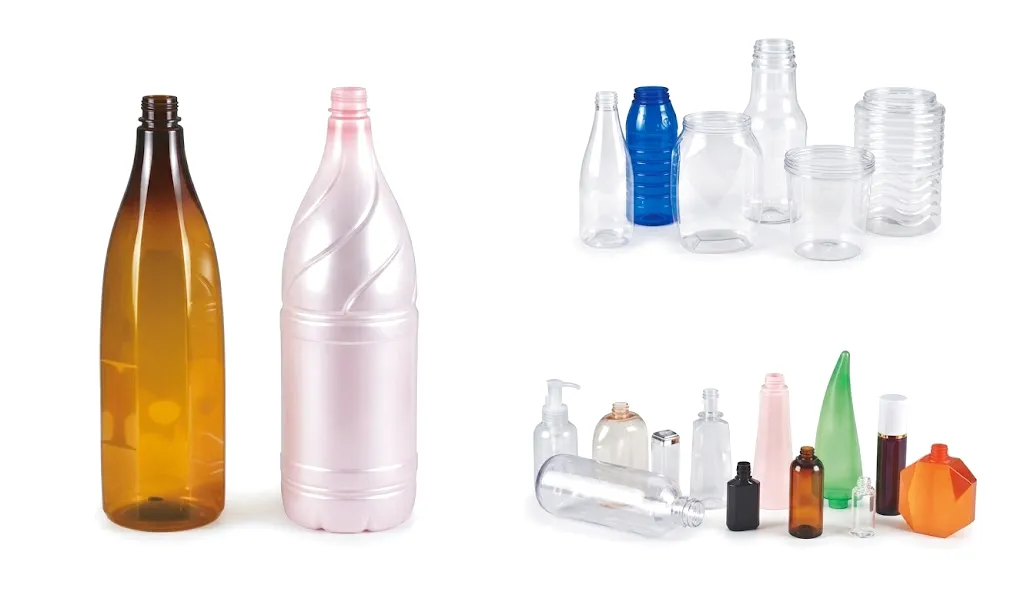
Sample Bottle Output from HGS Series
Technical Specifications — HGS Series Semi-Automatic Blow Molding Machine
Power supply: 220V / 50Hz. Operating pressure: 0.5–0.8 MPA. Blowing pressure: 3.0 MPA (all models).
Auxiliary Equipment: HGJ Series Infrared Preform Heater Parameters
The HGJ Series heater is a standalone auxiliary unit — it is not part of the HGS blow molding machine itself. It is sold and shipped separately as part of a complete two-step SBM production line.
Application Scenarios Across UK Industries
The HGS Series semi-automatic blow molding machine serves production lines across a broad spectrum of sectors where PET bottle clarity, structural rigidity, and FDA/food-contact compliance are non-negotiable. In the UK’s thriving craft beverage sector — artisan water, cold-pressed juice, premium cordials — the machine produces bottles that carry the visual premium consumers associate with upmarket brands. Pharmaceutical liquid packaging operations use the machine to produce clearly labelled, tamper-evident PET bottles where wall consistency is a regulatory requirement rather than a preference. Personal care and cosmetics brands operating regional UK production sites use the HGS for shampoo, conditioner, and body wash bottles up to 5 litres, often running mixed-format production across a single shift.
Beverages & Water
Personal Care & Cosmetics
Pharmaceutical Liquids
Agrochemical & Industrial
Hot-Fill Tea & Juice
Contract Packaging
Manufacturing Capability & Custom Configuration Service
Our production facility operates with a dedicated engineering design team focused specifically on PET stretch blow molding equipment. For UK buyers with non-standard requirements — unusual bottle geometries, dual-material neck inserts, specialised mould materials for high-abrasion resins, or bespoke integration with existing filling lines — our technical team provides full custom configuration support from initial consultation through to factory acceptance testing (FAT). We supply detailed CAD drawings, mould specification sheets, and complete installation manuals in English as standard. All machines undergo a full run-off test prior to despatch, with documented output data and quality records provided to the buyer.
Our customisation programme covers mould cavity design, pillar spacing adjustment for non-standard preform geometries, custom heating zone profiles for specialist PET blends (including rPET and PET-G copolymers increasingly specified by UK sustainability-focused brands), and mechanical integration work for downstream labelling or cap-application equipment. Spare parts packages with UK warehouse stocking arrangements are available for buyers running production-critical lines. Whether you are commissioning a single HGS150A for a pilot plant or specifying an HGS-350A for a large-format water container line, our team works to your specific production targets and site constraints.
📍 Serving the United Kingdom & Europe
We supply and support semi-automatic blow molding equipment across England, Scotland, Wales, and Northern Ireland, with logistics routed through UK port agents and direct technical support available in BST/GMT time zones. Machines can be configured for CE-marked export compliance and supplied with UKCA documentation on request.
Customer Success: A Real-World Deployment
Case Study · Scotland, UK · Premium Spring Water
Highland Spring Water Brand Upgrades to HGS-280A
A Scottish craft spring water producer supplying major UK grocery multiples was running an ageing European semi-automatic blow station with chronic spare part lead times of 14–18 weeks. Their production team contacted us after evaluating three machine suppliers. They required a machine capable of running 10-litre PET containers for their catering channel at a minimum of 600 bph, with hot-fill compatibility for a new pasteurised variant they were launching into food service. After a technical review, the HGS-280A was recommended. The machine was delivered to their Perthshire facility within 11 weeks of order, commissioned in two working days by our field technician, and reached target output on day three of operator-led production.
Within four months of installation, the customer had reduced bottle rejection rates from 4.2% to below 0.8%, attributed primarily to the more consistent infrared heating profile achieved through the paired HGJ-CL heater unit. Mould changeover time dropped from approximately 90 minutes to under 35 minutes following operator training on the HGS tooling system. The production manager confirmed that the machine had exceeded their original throughput specification by 8–11% under typical shift conditions.
What Our UK & European Clients Say
“We were sceptical about sourcing a semi-automatic blow molding machine outside of Europe, but the HGS-200A arrived exactly as specified and the commissioning process was genuinely straightforward. The hot-fill capability of the HGS-200B, which we ordered for our juice line six months later, has been exceptional.”
— Operations Director, Yorkshire Juice Producer, UK
“We run the HGS-350A for 20-litre water containers. The mould changeover is manageable with two people, and the machine has been running three shifts without a significant mechanical issue for over fourteen months. The blow consistency across a long run is better than machines we have previously operated at twice the price.”
— Plant Manager, Mineral Water Bottling, Germany
“As a UK contract packer we need flexibility above all else. The HGS-250A handles our full SKU range from 2-litre juice bottles to 5-litre detergent containers on the same mould platform. The team responded within hours to a tooling query during our first month of operation — that kind of after-sales support is what keeps us loyal to this supplier.”
— Technical Director, Contract Packaging Co., Midlands, UK
Injection Blow Molding Machine Replacement Models
If your operation currently runs an older injection blow molding (IBM) machine and is evaluating direct replacement options, our ZQ Series offers a modern upgrade path with improved energy efficiency, digital controls, and substantially shorter lead times versus OEM sourcing. Two frequently specified replacement models are detailed below:
ZQ135 — SUMA 175iB IBM Replacement
A direct technical replacement for the SUMA 175iB injection blow molding machine, the ZQ135 delivers a compatible mechanical envelope with updated PLC controls and improved energy management. Suitable for pharmaceutical, personal care, and beverage bottle production in single-stage IBM format.
ZQ40 — Uniloy UIB 70 IBM Replacement
Engineered as a direct replacement for the Uniloy UIB 70 injection blow molding machine, the ZQ40 is a compact, high-precision option for smaller-format bottles where shot accuracy and neck finish consistency are critical. Popular with UK pharmaceutical and cosmetic packaging operations.
Frequently Asked Questions
What is the price of a semi-automatic blow molding machine for PET bottles in the UK?
The cost of an HGS Series semi-automatic blow molding machine varies by model and configuration. Entry-level models such as the HGS150A are positioned for smaller UK operations and pilot production lines, while large-format models like the HGS-350A command a higher investment due to their 20-litre container capability. Please contact our sales team at [email protected] for a detailed quotation tailored to your bottle specification and annual volume.
How does a two-step semi-automatic stretch blow molding machine differ from a one-step injection blow molding machine?
In a two-step SBM process, preforms are produced separately by an independent injection moulding machine and then transferred to the HGS blow station for reheating and forming. A one-step injection blow molding machine combines both stages in a single cycle. The two-step approach allows preforms to be sourced in bulk and stored, offering greater scheduling flexibility for UK contract packers and multi-SKU operations.
Which semi-automatic blow molding machine model is best for hot-fill tea bottle production in a UK beverage plant?
The HGS-200B is specifically engineered for hot-fill applications, rated for continuous operation at 88–95°C. This makes it well-suited to UK tea, juice, and isotonic beverage producers requiring bottles compatible with Pasteurisation-line processes. Confirm your specific fill temperature and neck finish requirements with our technical team before finalising your specification.
Where can I find a reliable supplier of semi-automatic stretch blow molding machines for small UK beverage manufacturers?
We supply the HGS Series to beverage, pharmaceutical, and personal care producers across England, Scotland, Wales, and Northern Ireland. Machines can be specified with CE and UKCA compliance documentation. Contact us at [email protected] for lead times, technical support, and pricing options suitable for smaller-volume UK operations.
What bottle sizes can the HGS Series semi-automatic blow molding machine produce?
The HGS range covers bottle capacities from 1 litre (HGS150A) through to 20 litres (HGS-350A). Intermediate capacities of 1.25L, 5L, and 10L are covered by the HGS-200A, HGS250A, and HGS280A models respectively. The HGS-200B handles 1.25-litre hot-fill bottles.
How long does delivery of a semi-automatic blow molding machine to the UK typically take?
Standard lead times range from 8 to 14 weeks from order confirmation, depending on the model and any custom mould or configuration work required. Logistics to UK ports are handled by our appointed freight agents. Confirm specific lead times and shipping terms at the point of quotation.
Can I get a custom mould design for a non-standard bottle shape on the HGS semi-automatic blow molding machine?
Yes. Our engineering team provides full custom mould design and fabrication for non-standard bottle geometries, including oval, square-shoulder, and handle-integrated forms. We supply detailed mould drawings for customer approval before manufacture. Custom mould lead time is typically 4–6 weeks.
What is the difference between the HGJ-B and HGJ-CL preform heater models that accompany the HGS blow molding machine?
The HGJ-B is designed for wide-mouth jar preforms (neck diameter 65–130mm, 18/36 preform holders). The HGJ-CL handles narrower-neck preforms with up to 96 holders and a 68mm neck diameter range, making it better suited to standard beverage bottle preforms. Both are auxiliary units sold separately from the HGS blow molding machine, requiring a 3-phase 4-wire power supply.
Ready to Specify Your HGS Blow Molding Machine?
Send us your bottle specification, production volume targets, and site details. Our technical team will recommend the right HGS model, confirm lead times, and provide a full commercial quotation within 24 hours (GMT/BST).
📧 Get a Quote — [email protected]
Serving England · Scotland · Wales · Northern Ireland · Republic of Ireland · EU · edit by gzl