Descripción
Industrial Auxiliary Equipment · UK Distributed
Auxiliary Machinery for Blow Moulding Lines
Complete peripheral support systems — air compressors, chillers, mould temperature controllers, and more — engineered for continuous PET and PP production environments across the United Kingdom.
What Is Auxiliary Machinery — And Why Does Every Blow Moulding Line Need It?
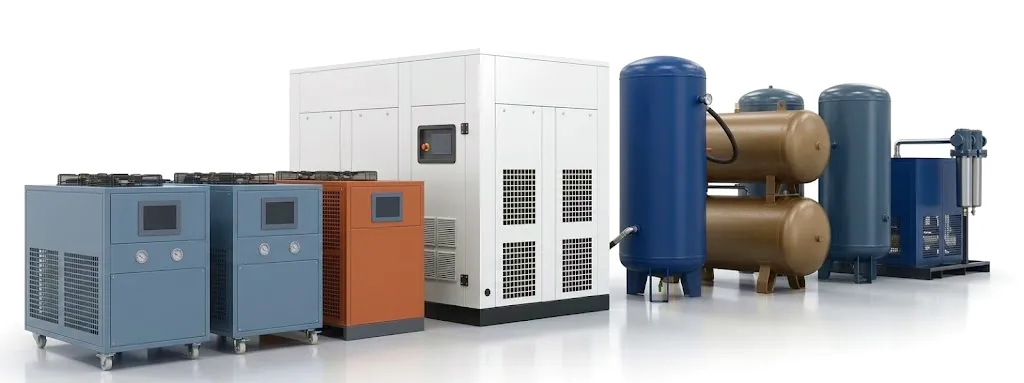
Running a PET or PP blow moulding operation without properly matched auxiliary machinery is a bit like trying to run a factory without electricity — technically possible in some narrow scenarios, but never sustainable at scale. The auxiliary machinery for blow moulding encompasses all the critical peripheral systems that keep the core machine running at optimal temperature, pressure, and efficiency: oil-free air compressors delivering the high-pressure air that actually inflates preforms into bottles, industrial water chillers maintaining precise mould temperatures to lock in dimensional accuracy, mould temperature controllers (MTCs) conditioning the cavity surface to within fractions of a degree, conveyor systems handling finished containers, and air-cooling units managing the thermal environment of the production hall. Together, these systems form the backbone of a high-output blow moulding line in food and beverage, pharmaceutical, personal care, and household chemical sectors across the UK and globally.
At ISBM Equipment, we have spent nearly two decades supplying auxiliary machinery packages to British packaging manufacturers, contract blow moulders, and OEM integrators. Our approach is not to retrofit generic industrial equipment — we configure, size, and validate each auxiliary unit against the specific cycle time, mould design, and environmental conditions of your site. Whether you operate a single-cavity stretch blow moulder or a 20-cavity high-speed rotary machine, we match the auxiliary machinery specification to the demand curve of your process, not the other way around. Every quote includes a thermal load calculation, compressed air flow analysis, and a noise-level assessment compliant with the UK Machinery Regulations and PSSR 2000 requirements.
Core Auxiliary Systems — What We Supply
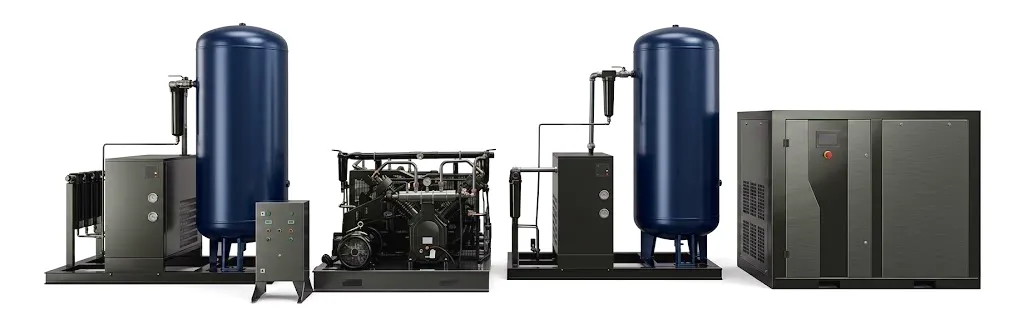
Oil-Free Air Compressor
Delivers clean, dry compressed air at 20–40 bar for preform stretching and blowing. Oil-free designs prevent contamination in food-grade and pharma bottle production. Units range from 7.5 kW to 315 kW to match output volumes from 500 to 60,000 bottles/hour.
Industrial Water Chiller
Maintains mould water circuits at 6–15°C for rapid cavity cooling, cutting cycle time and preventing thermal deformation. Scroll and screw compressor designs available; capacities from 5 kW to 500 kW. All units are R-410A or R-32 refrigerant, CE marked and F-Gas compliant.
Mould Temperature Controller
Precision water-based or oil-based temperature control units hold mould cavities to ±0.5°C. Essential for complex multi-layer containers and wide-mouth jars where thermal consistency determines wall thickness uniformity. PID control with digital display and remote setpoint adjustment.
Air-Cooled Cooling Tower
For sites where chilled water return loops need additional heat rejection before re-entering the chiller. Closed-circuit cooling towers with stainless steel coils eliminate water contamination and reduce biological fouling risk — a key requirement in UK food and beverage facilities.
Air Dryer & Filter System
Refrigerated and desiccant dryers with multi-stage filtration (particulate, coalescing, activated carbon) ensure compressed air meets ISO 8573-1 Class 1 purity — mandatory in pharmaceutical and food-contact packaging applications. Pre-configured to match the rated flow of paired compressors.
Conveyor & Bottle Handling
Modular air-conveyor and belt conveyor systems for transferring finished bottles from the blow moulding machine to filling, capping, or labelling stations. Designed for speeds up to 72,000 bottles per hour with low-friction UHMWPE guides and variable-speed drives.
Technical Specification — Auxiliary Machinery Range
The following table covers the principal technical parameters of our auxiliary machinery series. All specifications are reference values; exact figures are confirmed after load calculation and site survey. Units are available in single-phase and three-phase configurations to match UK electrical supply standards (230V/50Hz and 400V/3ph/50Hz).
| Parameter | Oil-Free Compressor | Industrial Chiller | Mould Temp. Controller | Air Dryer |
|---|---|---|---|---|
| Motor Power | 7.5 kW – 315 kW | 1.5 kW – 90 kW | 3 kW – 24 kW | 0.4 kW – 15 kW |
| Cooling / Flow Capacity | 1.0 – 50 m3/min FAD | 5 kW – 500 kW cooling | 20 – 120 L/min | 1.0 – 60 m3/min |
| Working Pressure / Temperature | 7 bar – 40 bar | 5°C – 25°C outlet | 20°C – 180°C (oil type) | Pressure dewpoint +3°C |
| Voltage / Power Supply | 400V / 3ph / 50Hz | 400V / 3ph / 50Hz | 230V or 400V / 50Hz | 230V / 1ph or 400V |
| Noise Level | 62 – 75 dB(A) | 55 – 70 dB(A) | less than 60 dB(A) | less than 65 dB(A) |
| Refrigerant / Medium | N/A (oil-free air) | R-410A / R-32 | Water / Thermal Oil | Refrigerated / Desiccant |
| Air Purity Class (ISO 8573-1) | Class 0 (oil-free) | — | — | Class 1 (with filters) |
| Certification | CE, UKCA, PSSR 2000 | CE, UKCA, F-Gas | CE, UKCA | CE, ISO 8573-1 |
| Warranty | 12 months | 12 months | 12 months | 12 months |
* All specifications are subject to confirmation. Custom configurations available on request.
How Auxiliary Machinery Works in a Blow Moulding System
Understanding the integration between each auxiliary unit and the blow moulding machine itself is what separates a well-engineered production line from one that runs unpredictably. In a standard two-stage injection stretch blow moulding (ISBM) setup, the air compressor provides two distinct air streams: a low-pressure circuit (around 7–8 bar) for pre-blowing and pneumatic actuators, and a high-pressure circuit (25–40 bar) for the final blow. The compressor must be sized to deliver the peak instantaneous flow demand across all active cavities simultaneously, with a reserve capacity of at least 15% to prevent pressure dip during rapid cycling. Undersizing the compressor — a common planning error — directly causes bottle shoulder failure and wall thickness variation.
The chiller loop runs in parallel, circulating temperature-controlled water through the mould’s internal channels. Water entering the mould typically targets 8–12°C for PET; the chiller must maintain this setpoint regardless of ambient hall temperature, which in UK production facilities can swing from 10°C in winter to 34°C in summer. Our chillers incorporate variable-speed compressor drives that modulate output to match real-time heat load rather than cycling on and off — this extends service life significantly and reduces peak power demand charges. The mould temperature controller, meanwhile, is used not for cooling but for precise heating in applications such as PP hot-fill containers, where the mould surface must be kept above 60°C to achieve crystallinity in the polymer wall.
Materials
316L stainless steel heat exchanger plates; UHMWPE conveyor guides; copper-wound motors; epoxy-coated carbon steel frames.
Typical Applications
PET water/CSD bottles, HDPE chemical containers, PP hot-fill jars, pharmaceutical vials, dairy packaging.
Industry Sectors (UK)
Food & Beverage, Personal Care, Household Chemicals, Pharmaceutical, Automotive Fluids, Agricultural Chemicals.
Seven Advantages That Matter to UK Packaging Producers
✅
UKCA & CE Dual Marked
All equipment carries both UKCA and CE marking, ensuring compliance for GB market sale and export to EU partner sites without re-certification.
⚡
Variable-Speed Drives (VSD)
Inverter-driven compressors and chillers cut energy consumption by 20–35% compared to fixed-speed alternatives, with payback periods under 18 months at typical UK electricity tariffs.
🔧
Matched System Design
Every auxiliary package is sized to the host blow moulding machine’s actual cycle data — no guessing. We supply the thermal and flow calculations with every quotation.
📦
Plug-and-Play Skid Options
Compressor, dryer, receiver, and filtration pre-assembled on a single skid frame. Reduces on-site installation time by up to 60% and simplifies PSSR commissioning documentation.
🌱
Low-GWP Refrigerants
R-32 and R-410A refrigerants with full F-Gas compliance. Our engineering team can advise on transition pathways as UK F-Gas phase-down schedules tighten through 2030.
📡
Remote Monitoring Ready
Optional IoT-enabled control panels with Modbus / MQTT integration allow real-time monitoring of pressure, temperature, and energy consumption via plant SCADA systems or mobile dashboards.
🛠️
UK Parts & Service Access
Critical wear parts — filter elements, belt kits, refrigerant service — are stocked in the UK for next-day dispatch. Service engineers available for scheduled PPM and emergency callouts.
Complete the Line — Related Blow Moulding Equipment
Auxiliary machinery performs best when it is selected alongside the rest of the blow moulding system. Two of the most frequently paired components with our auxiliary packages are the tooling sets that define container geometry and the preform production equipment upstream. Our Blowing Mold range covers single-cavity prototype tooling through to high-cavity production moulds in aluminium and P20 steel, designed for rapid heat transfer to work efficiently with the chilled water circuits supplied by our auxiliary machinery. For operations that produce their own preforms in-house, the Preform Injection Mold series offers hot-runner multi-cavity systems in 8 to 96 cavities, compatible with all major injection moulding machine brands used in UK manufacturing. Specifying the blowing mould, preform mould, and auxiliary systems from a single supplier streamlines commissioning, warranty management, and long-term technical support.
Customer Success Cases
Real results from packaging manufacturers who integrated our auxiliary machinery into their production lines.
Case Study
Midlands Beverage Packer — PET Water Bottle Line Upgrade
West Midlands, United Kingdom · Food & Beverage Sector
A regional contract packer based in Coventry running two ageing 4-cavity ISBM lines approached us in early 2024 with a persistent problem: inconsistent bottle weight — some units running 2–3 grams heavy — traced back to inadequate mould cooling. Their existing chiller had been undersized at the original project stage and could not maintain below 14°C during summer months, causing partial reheating of the polymer in the cavity between cycles.
We supplied a 45 kW variable-speed industrial chiller with a 1,000-litre buffer tank and a dedicated mould temperature controller for each line. The new configuration held cavity water at 9°C ±0.5°C through a full summer production season. Bottle-weight variance narrowed to less than 0.4 grams across both lines, reducing raw material waste by approximately 1.8 tonnes annually and cutting rejection rates from 4.2% to under 0.7%. The site’s energy bill for cooling fell by 22% despite adding a second controlled circuit, thanks to the inverter drive on the new chiller.
-78%
Rejection rate reduction
-22%
Cooling energy cost
1.8 t
Annual resin saving
“
We had never bought a full auxiliary package from a single supplier before. The thermal calculation sheet they sent with the quote was what convinced us — it showed exactly why our old chiller was failing in summer. The new system has been faultless for eighteen months.
Production Manager
Contract Packaging, Coventry, UK
“
The oil-free compressor skid arrived pre-wired and pre-plumbed. Our engineers had it online in four hours. For a pharmaceutical site with strict contamination protocols, the Class 0 certification was non-negotiable — and the documentation pack they supplied was exactly what our QA team needed for site validation.
Engineering Director
Pharmaceutical Packaging, Cambridge, UK
“
We run three ISBM machines across two shifts. Having the mould temperature controllers networked to our SCADA via Modbus has been a game-changer for process visibility. When one zone drifts, the operator sees it immediately rather than discovering a quality problem three hours later.
Plant Operations Manager
FMCG Plastics Converter, Manchester, UK
Factory Capability & Custom Engineering
Our manufacturing facility operates across 18,000 square metres of dedicated production and testing space. Every auxiliary machine leaving the factory undergoes a full-load performance test: compressors run at rated pressure and flow for a minimum of four hours; chillers are tested across their full temperature setpoint range with logged data provided as part of the factory acceptance test (FAT) documentation. This is not a formality — it is how we ensure that what we ship matches what we specified.
Customisation is a genuine capability, not a marketing claim. We design and manufacture bespoke auxiliary solutions for projects that standard catalogue equipment cannot address: explosion-proof (ATEX Zone 2) compressor and chiller sets for chemical filling environments; hygienic-design stainless steel chiller housings for food-safe cleanroom installations; custom pipe manifold assemblies to feed multiple blow moulding machines from a single centralised utility skid; and ultra-quiet acoustic enclosures for production facilities in noise-sensitive urban locations across the UK. Our in-house engineering team handles mechanical design, electrical schematic production, and PLC programming, giving clients a single accountable partner from specification through commissioning.
Frequently Asked Questions
Questions from UK packaging buyers and production engineers
Ready to Spec Your Auxiliary Package?
Send us your machine model, output target, and site details — we return a thermal calculation and budgetary quote within two working days.
ISBM Equipment · [email protected] · UKCA & CE Certified · UK Delivery Available · edit by gzl