Industrial Blow Moulding Equipment · UK B2B Technical Guide
IBM Blow Molding Machine: Complete Technical Guide for UK Manufacturers & Procurement Teams
How does IBM compare to ISBM, EBM and extrusion moulding? What wall-thickness tolerances, mould designs and energy profiles matter most for British plastics processors? This guide answers every question — from Birmingham packaging lines to Sheffield pharmaceutical cleanrooms.
IBM vs ISBM, EBM and Extrusion Blow Moulding: Process-by-Process Comparison
Understanding where IBM fits in the plastics processing landscape requires a clear-eyed comparison of all four major blow moulding routes. Each process offers a distinct trade-off between dimensional precision, material flexibility, tooling investment, and output rate. UK buyers evaluating capital expenditure proposals for a new container line should map their product specification firmly against these distinctions before committing to a machine platform.
| Process | Neck Precision | Wall Uniformity | Materials | Typical Volume Range | Flash / Trim Waste | Best Application |
|---|---|---|---|---|---|---|
| IBM | Excellent (±0.1 mm) | Very High | PE, PP, PET, PVC, PS | 2 ml – 1,000 ml | None | Pharma, cosmetics, personal care |
| ISBM | Good (±0.2 mm) | High | PET, PP | 50 ml – 5,000 ml | None | Beverages, food, wide-mouth jars |
| EBM (Extrusion Blow) | Moderate (±0.4 mm) | Moderate | HDPE, LDPE, PP, PVC | 50 ml – 20,000 ml | Yes (flash trimming needed) | Jerricans, tanks, automotive parts |
| Two-Step REHEAT Stretch | Good (±0.2 mm) | High (biaxially oriented) | PET primarily | 200 ml – 10,000 ml | None | High-volume beverage, CSD |
IBM stands apart from extrusion-based routes because the preform geometry is fully defined before blowing begins. There is no parison swell to compensate for, no flash trimming to budget for, and no downstream trim granulator to maintain. For regulated pharmaceutical applications — where every container must pass dimensional gauging before filling — the IBM injection blow molding machine delivers a baseline process capability (Cpk) that extrusion routes simply cannot match without expensive corrective tooling. Sheffield-based pharmaceutical packagers, for example, have adopted IBM lines specifically because the process satisfies both BSI and EU GMP container standards without secondary operations.
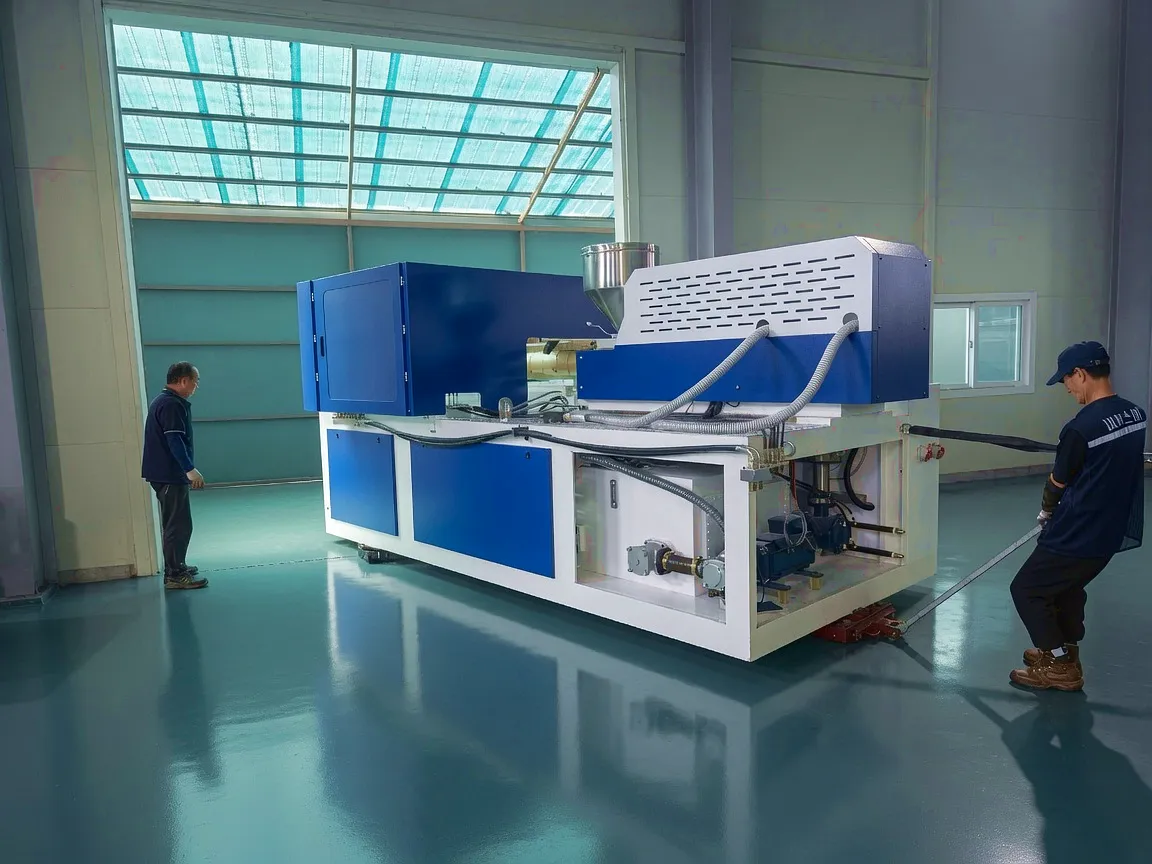
How an IBM Blow Molding Machine Works: Station-by-Station Breakdown
Wall Thickness Control
±0.05 mm Uniformity
Wall thickness uniformity in IBM is governed primarily by core-rod geometry and preform mould temperature. Because the preform is shaped before blowing, any asymmetry in material distribution is designed in at the tooling stage rather than compensated during blowing. Core-rod surface temperature is maintained within ±2°C using internal water cooling, preventing premature skin formation on the inner preform surface. IBM injection blow molding lines running HDPE pharmaceutical bottles in Birmingham cleanrooms routinely achieve average wall thickness Cpk values above 1.67, meeting the capability thresholds demanded by multinational pharmaceutical clients for primary packaging qualification.
Preform Temperature Profile
Zone-Segmented Barrel Heating
The injection barrel on a modern IBM blow molding machine is divided into four to six independently controlled heating zones, each with PID temperature controllers holding ±1°C accuracy. For HDPE, barrel temperatures typically progress from 170°C at the feed throat to 210°C at the nozzle. PP runs slightly hotter: 200–235°C across the zones. PET in IBM applications requires tighter control — 265–285°C — to prevent acetaldehyde generation while ensuring sufficient melt homogeneity. The hot-runner manifold (on multi-cavity IBM tools) is held at a separate setpoint, typically 5–10°C above the nozzle, to prevent freeze-off between shots. Accurate preform temperature profiling is the single most impactful parameter for wall uniformity and optical clarity in finished pharmaceutical bottles.
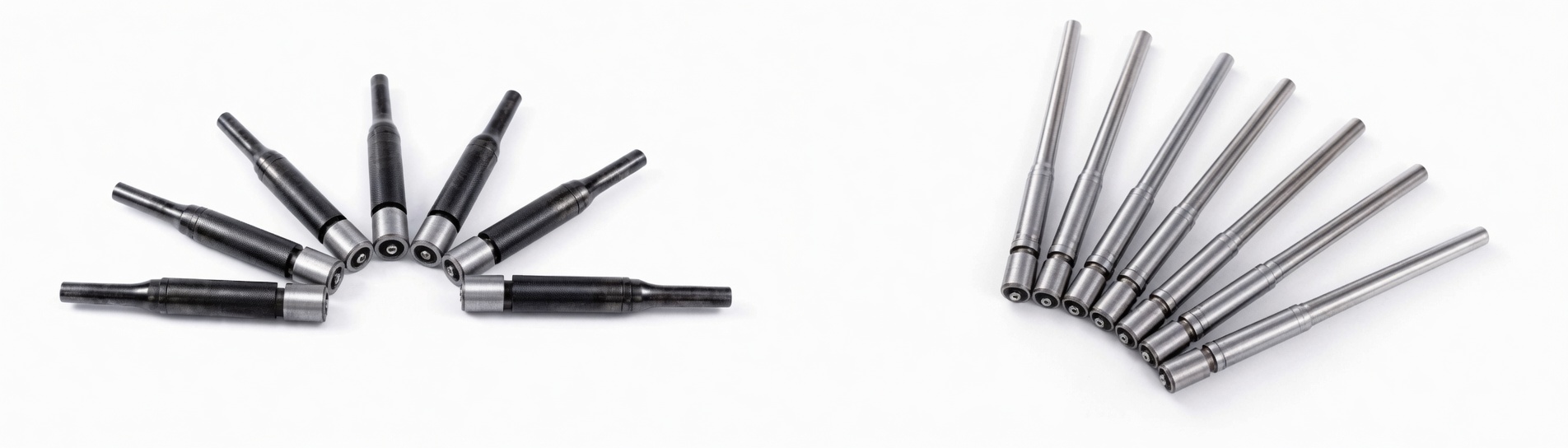
Core Materials Used in IBM Blow Moulding: Polymer Selection Guide
Material selection for an IBM blow molding machine production run is not a cosmetic decision — it determines chemical resistance, regulatory compliance, mechanical performance under downstream filling-line stress, and recyclability under UK PPT classification rules. Each polymer family processes differently through the IBM injection-blow cycle, demanding specific barrel profiles, core-rod temperatures, and blow pressures. The following cards summarise the four dominant IBM resins used by UK plastics processors.
HDPE
High-density polyethylene remains the most widely IBM-processed resin in the UK pharmaceutical and household chemical sectors. Its high chemical resistance, FDA/MHRA compliance, and excellent ESCR (Environmental Stress Crack Resistance) make it the preferred choice for liquid detergents, shampoos, and oral solid dose bottles. HDPE runs cleanly through IBM tooling at 180–215°C with minimal degradation risk, and its stiffness-to-weight ratio supports thin-wall designs that reduce material usage per bottle — directly beneficial under the UK Plastic Packaging Tax framework.
PP (Polypropylene)
Polypropylene is the material of choice for wide-mouth IBM containers — cream jars, tablet dispensers, and multi-piece cosmetic packaging — due to its excellent hinge fatigue resistance, higher heat deflection temperature (up to 130°C for autoclave-compatible grades), and compatibility with push-pull flip-top closures. In IBM processing, PP requires careful core-rod temperature management because its crystallisation onset is rapid; a core-rod surface above 60°C can trigger premature skinning on the preform interior. Nottingham-based cosmetics converters processing PP on IBM lines typically achieve 24-cavity outputs of 3,600–5,400 bottles per hour.
PET (Polyethylene Terephthalate)
PET in IBM processing — as distinct from ISBM — yields amorphous containers with excellent optical clarity and glass-like surface gloss that premium skincare brands in London and Edinburgh actively specify. Because IBM-PET containers are not biaxially oriented, they lack the barrier and pressure-resistance properties of ISBM-PET, but their surface aesthetics and dimensional precision for small formats (15–150 ml) are superior. IBM-PET must be processed dry (moisture content below 0.004%) to prevent hydrolytic degradation; an on-machine or standalone crystallising dehumidifying dryer reducing dew-point to -40°C is standard practice on well-configured UK lines.
PVC & Speciality Grades
Medical-grade PVC and certain speciality thermoplastics — including TPE and PETG — are processed on IBM blow molding machines for parenteral pharmaceutical containers, eye-drop bottles, and diagnostic reagent packaging. PVC IBM processing requires corrosion-resistant barrel and screw metallurgy (bi-metallic nitrided screw flight recommended) and controlled residence time to prevent HCl evolution. PETG is gaining traction in UK veterinary pharmaceutical packaging due to its superior chemical resistance over standard PET and its suitability for gamma sterilisation — a procurement requirement for many Leeds and Cambridge contract pharmaceutical manufacturers.
Mould Design and Bottle Geometry Optimisation for IBM Lines
Parting-line placement in IBM blow moulds is another design variable with significant downstream consequences. Because IBM produces containers without flash, there is no post-mould trimming operation to remove a parting-line witness mark — what is moulded is what ships. For round containers destined for pharmaceutical labelling, the parting line is typically placed at 90 degrees to the flat label panel to remain invisible under applied pressure-sensitive labels. Oblong and oval IBM containers for toiletry applications require parting lines on the narrow faces, which imposes a constraint on mould-opening direction that must be communicated clearly to machine builders when specifying platen geometry and mould mounting arrangements.
Technical Advantages of IBM Blow Molding Machines
▶
No Flash, No Trim Waste
IBM produces flash-free containers in a single machine cycle, eliminating the flash-grinding granulator, the downstream trim conveyor, and the associated labour cost of manual flash inspection. For a UK mid-size converter running three shifts, the elimination of flash-grinding operations on a comparable extrusion line saves approximately 180–260 operating hours per year per line and removes a significant source of contamination risk in pharmaceutical environments.
▶
Superior Neck Integrity
The injection-formed neck thread on an IBM bottle is hardened against the injection-mould core and cavity steel, yielding thread engagement that consistently passes torque-test validation at capping speeds up to 3,000 closures per minute. For UK OTC pharmaceutical packers using automated induction-seal lines, neck integrity that holds to ±0.1 mm on thread major and pitch diameter eliminates the head-pressure failures and capping torque rejections that can occur on extrusion-blown or trimmed necks.
▶
Compact Footprint, Low Ancillary Cost
IBM machines are mechanically compact relative to their output rate. A 16-cavity IBM blow molding machine producing 50 ml HDPE pharmaceutical bottles occupies approximately 3.5 m x 2.2 m of floor space, compared with a two-step EBM line with equivalent output requiring over 12 m of linear floor space including parison die, clamping unit, flash trimmer, and granulator. UK manufacturing sites — particularly in older industrial parks around Leeds, Leicester, and Wolverhampton — consistently cite floor space efficiency as a primary IBM selection criterion.
▶
Energy Efficiency vs Extrusion Routes
Because the preform retains injection heat and transitions directly to the blow station without a reheat step, the IBM process avoids the single largest energy sink in two-stage ISBM — the infrared oven. Energy benchmarks from independent UK plastics processing audits show IBM lines consuming 0.12–0.18 kWh per kg of processed polymer, versus 0.28–0.38 kWh/kg for two-stage ISBM lines of equivalent output. In a UK energy market where industrial electricity prices have remained elevated since 2022, this difference meaningfully improves cost-per-container economics for medium-run pharmaceutical and cosmetic production.
IBM Blow Molding Machine — Technical Performance Specification Table
Application Scenarios: Where IBM Blow Molding Machines Are Deployed in UK Industry
💊
Pharmaceutical Packaging (Sheffield / East Midlands)
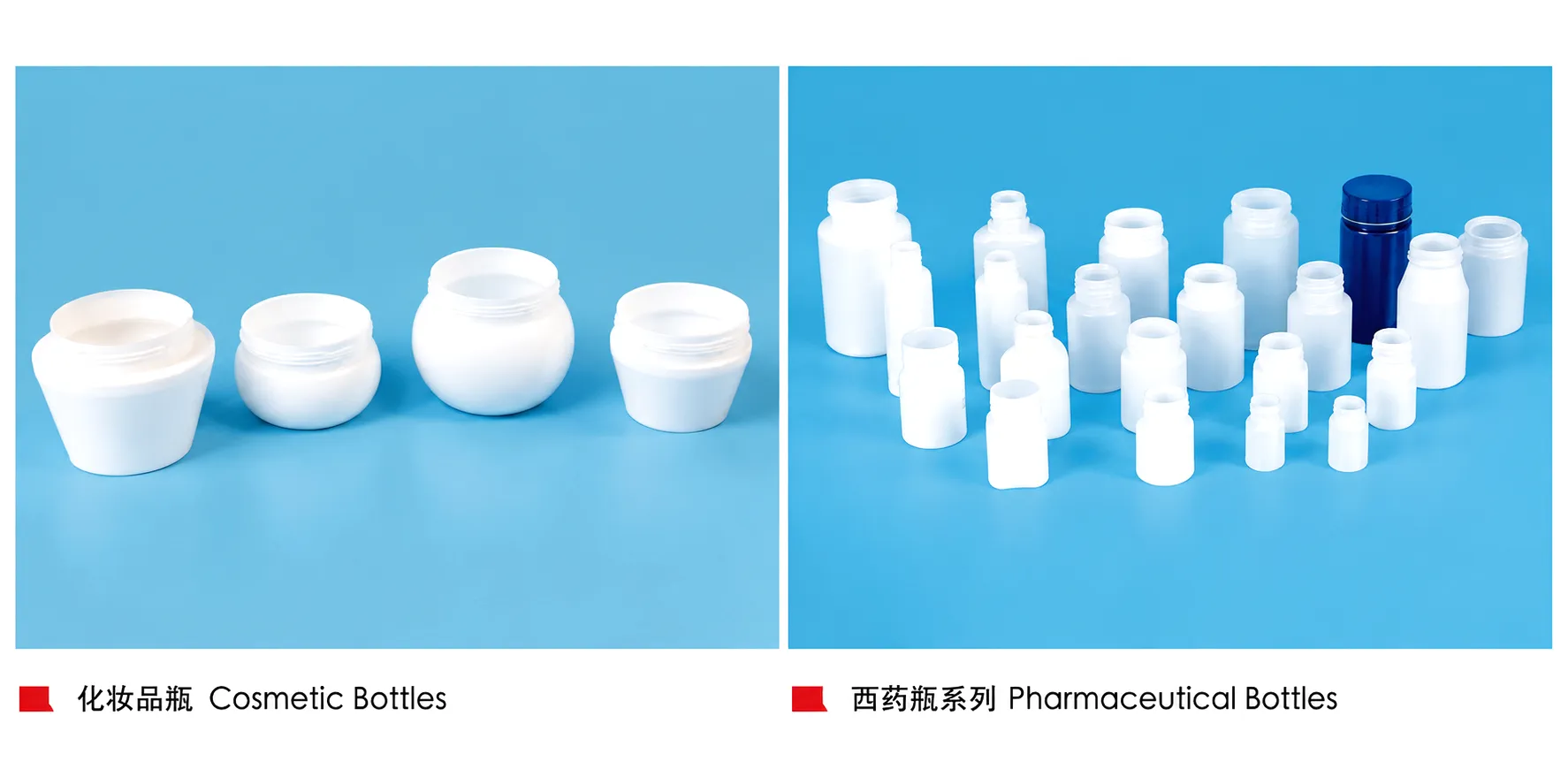
Amber HDPE tablet bottles, PP paediatric syrups, PET/PETG ophthalmic drops, nasal spray primary containers. IBM machines dominate due to flash-free production, thread precision, and GMP cleanroom compatibility.
💐
Cosmetics & Personal Care (London / Leeds)
Serum dropper bottles, shampoo and conditioner containers, pump-dispenser flasks, lip-gloss tubes. IBM-PET clarity and surface gloss rival glass at a fraction of the weight and cost.
🏠
Household Chemicals (Birmingham / Coventry)
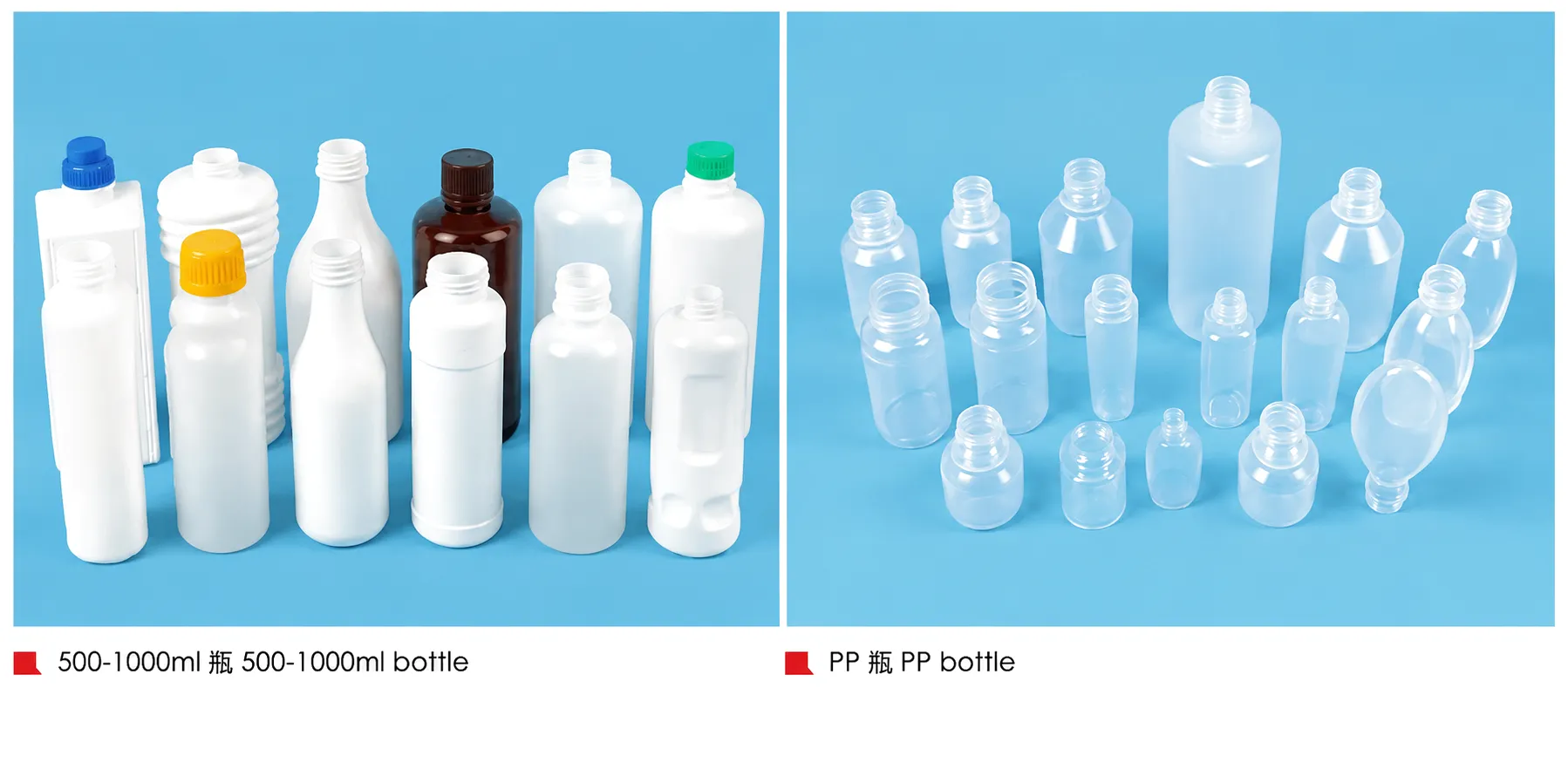
Concentrated detergent dosing bottles, fabric conditioner top-caps, bathroom cleaner trigger-top containers, CRC-compatible HDPE bottles. Thread integrity supports child-resistant closure certification.
⚕
Veterinary & Diagnostics (Cambridge / York)
PETG gamma-sterilisable reagent bottles, parenteral PVC containers for IV line attachments, animal health topical treatment dispensers. IBM PETG sterilisation compatibility is a growing UK procurement requirement.
IBM Machine Troubleshooting: Common Faults and Corrective Actions
IBM blow molding machines, while mechanically robust, are susceptible to a predictable set of process faults that operators and maintenance engineers should be equipped to diagnose rapidly. The following troubleshooting table addresses the most commonly reported issues on UK pharmaceutical and personal care IBM lines, with root cause analysis and corrective action guidance.
Energy Optimisation and Retrofit Strategies for IBM Blow Moulding Lines
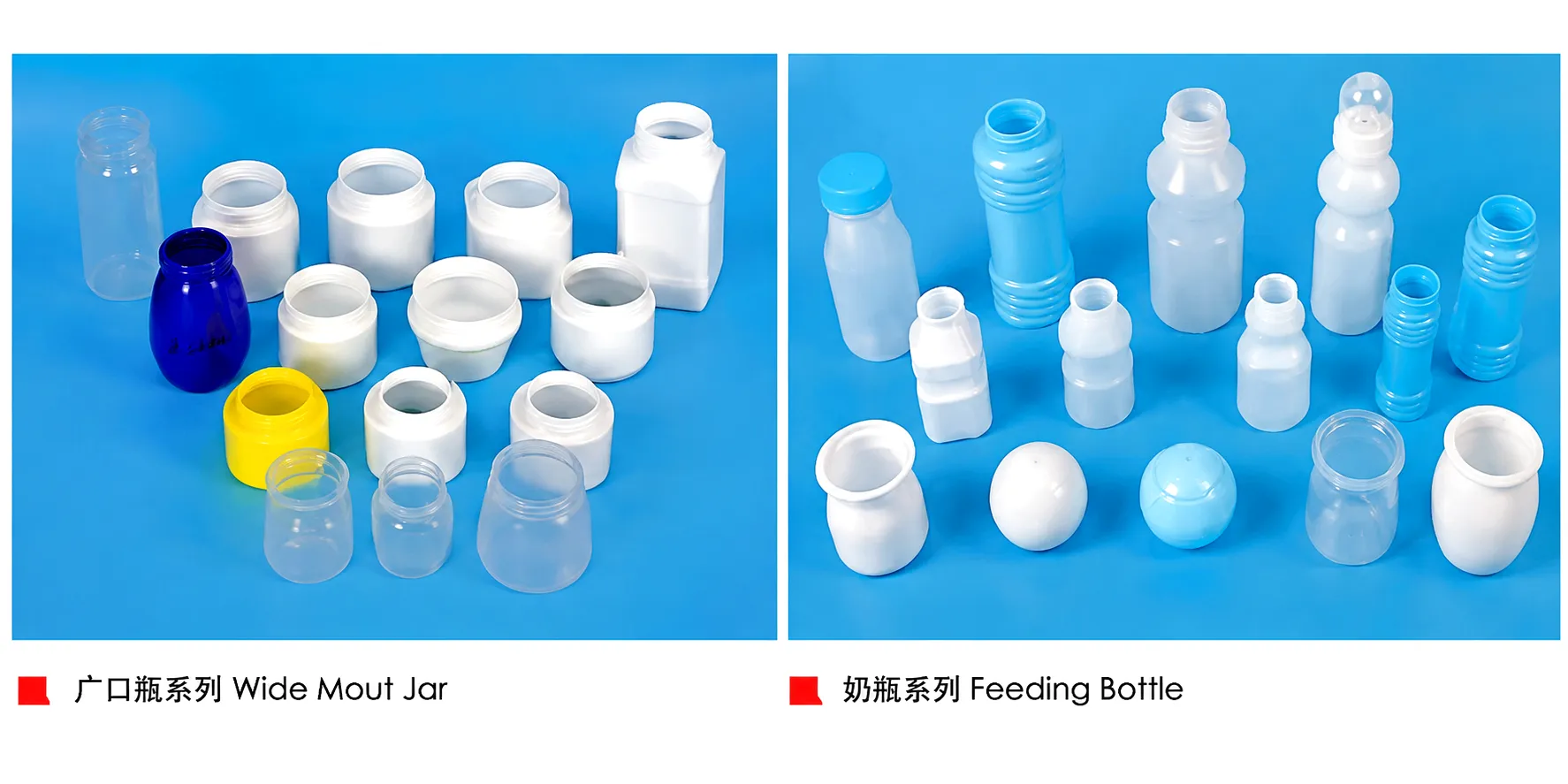
Ever Power: IBM Blow Molding Machine Manufacturing & Customisation Capability
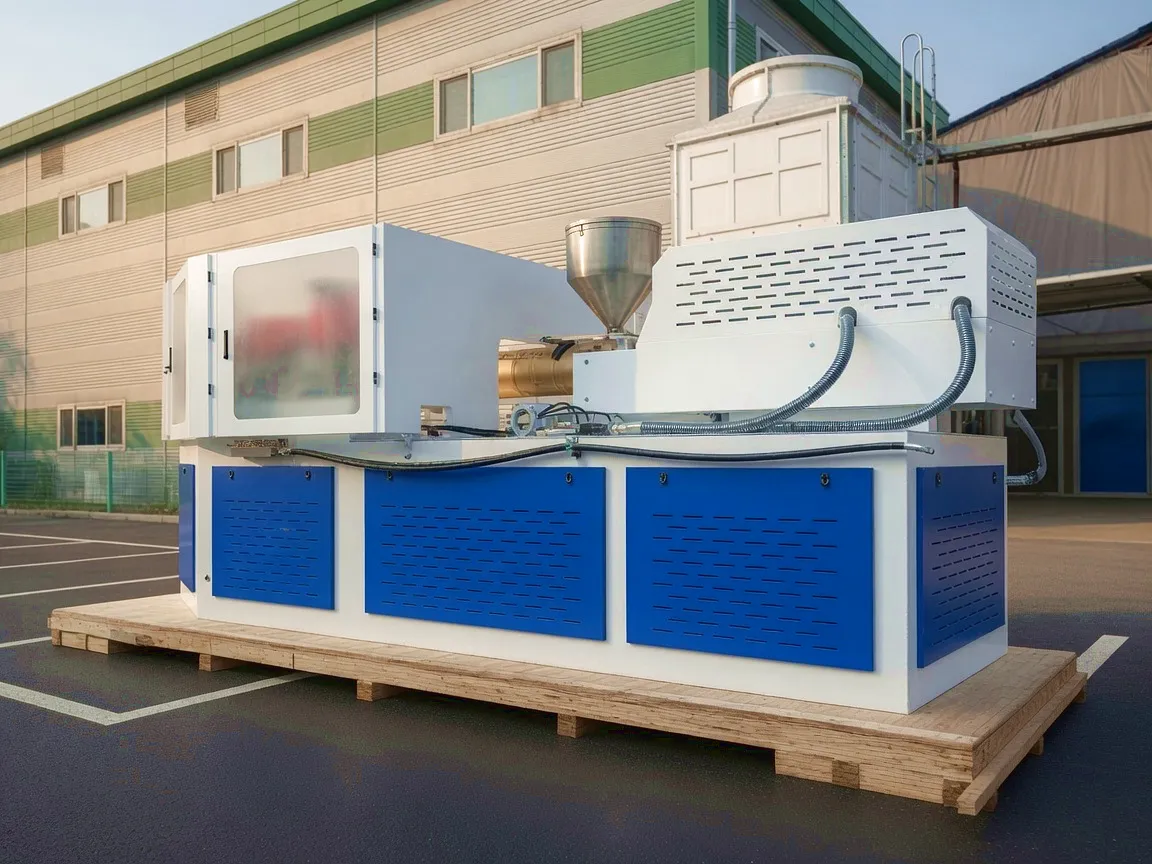
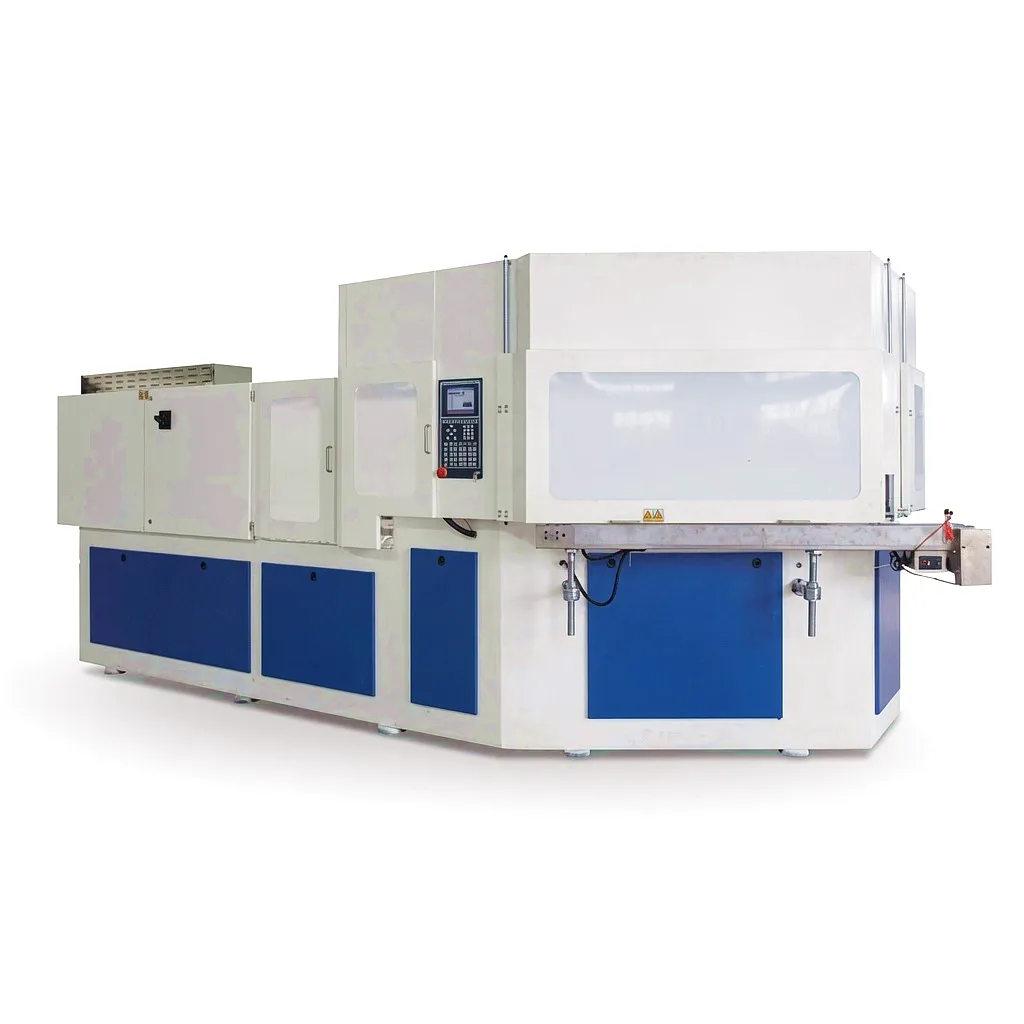
Ever Power
ZQ110 Injection Blow Molding Machine
A compact, high-precision IBM platform delivering 110 kN injection clamping force, 24-cavity capacity, and servo-hydraulic drive efficiency. Ideal for UK pharmaceutical and cosmetics converters producing 5–500 ml containers in HDPE, PP, and PET. Fast mould change design reduces product switchover downtime to under 45 minutes.
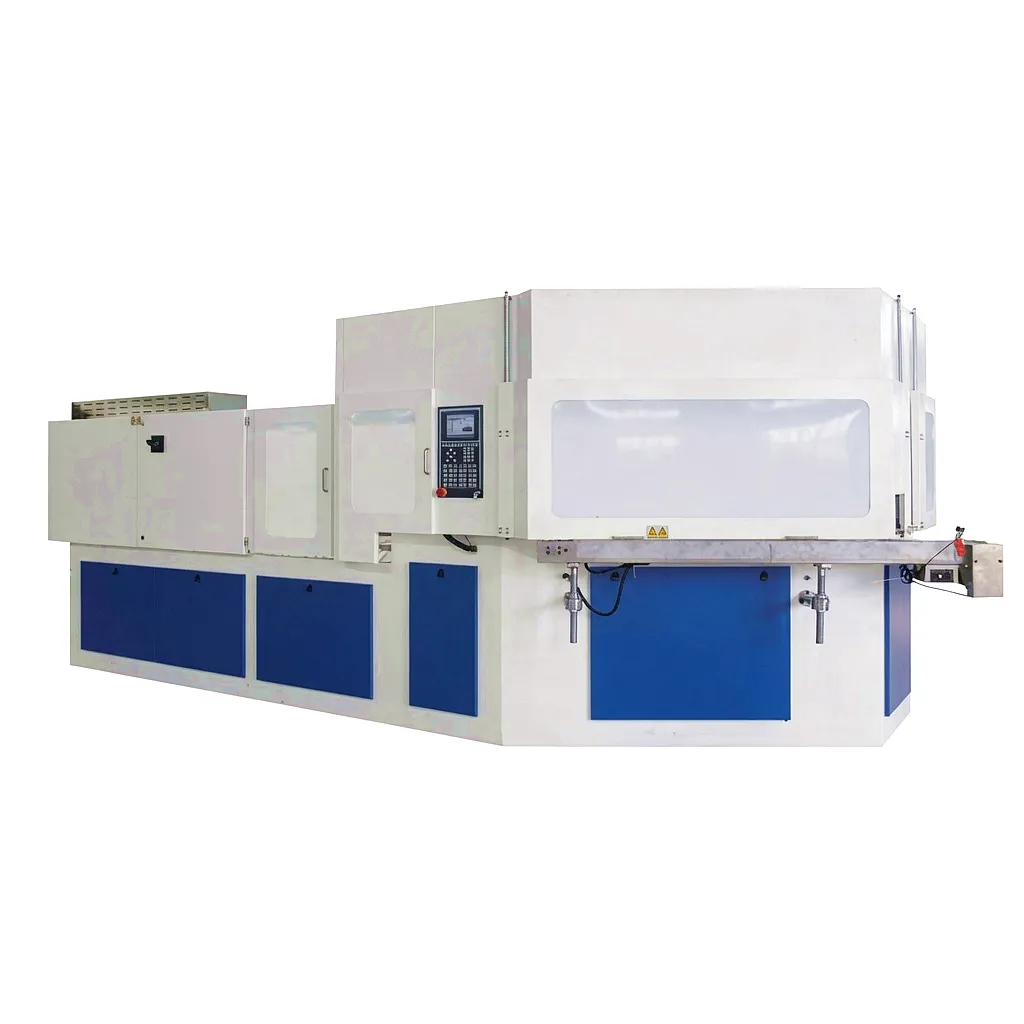
Ever Power
ZQ135 Injection Blow Molding Machine
The ZQ135 scales up Ever Power’s IBM precision to 135 kN injection clamping force and 32-cavity tooling configurations, delivering output rates of up to 5,760 containers per hour for 50 ml HDPE pharmaceutical bottles. The extended platen area accommodates larger-diameter blow moulds for 250–1,000 ml container formats popular with UK household product and mid-volume cosmetics brands.
Discuss custom IBM specifications, cavity counts, resin compatibility, or cleanroom build requirements with Ever Power’s technical team.
Customer Success Story: Sheffield Pharmaceutical Packaging Converter Upgrades to Ever Power IBM Line
Case Study · Sheffield, South Yorkshire · Pharmaceutical Packaging
A mid-size contract pharmaceutical packaging converter based on the Sheffield industrial estate corridor — processing an annual volume of approximately 18 million HDPE oral solid dose and liquid medicine bottles — operated two ageing fixed-displacement hydraulic IBM blow molding machines that were producing escalating reject rates on thread-dimension gauging, consuming 38 kW per machine, and requiring an average of 6.2 hours downtime per week per line for hydraulic seal and valve maintenance. The quality manager’s quarterly reports had flagged a sustained 2.8% out-of-tolerance reject rate on 60 ml amber HDPE bottles — above the 1.5% threshold specified in the company’s pharmaceutical client supply agreements.
After a competitive evaluation process, the converter’s procurement team selected Ever Power’s ZQ135 injection blow molding machine platform with two full-line installations. The ZQ135 machines incorporated servo-hydraulic drives, conformal-cooled blow moulds designed by Ever Power’s in-house tooling team to the converter’s existing container drawings, and a bespoke hot-runner manifold balanced for the specific HDPE grade used in their pharmaceutical production. Ever Power’s project engineer conducted on-site IQ and OQ support during the four-week installation and commissioning phase, providing documentation in the format required by the converter’s pharmaceutical QMS.
Within six weeks of full-rate production, the Sheffield facility reported a thread out-of-tolerance reject rate of 0.4% — well below the 1.5% client threshold — and measured a 39% reduction in machine energy consumption to 23.1 kW average per line. Annual maintenance downtime per line fell to under 1.8 hours per week. The two ZQ135 machines paid back their combined capital investment within 26 months through energy savings, reduced scrap costs, and the recovery of a previously lost pharmaceutical contract that had been withdrawn due to quality concerns. The Sheffield site is now evaluating a third ZQ135 installation to support projected volume growth from an EU pharmaceutical distribution expansion.
★★★★★
“The ZQ135 thread precision has transformed our pharmaceutical client retention. We went from a 2.8% reject rate to 0.4% within six weeks — the conformal-cooled tooling Ever Power supplied made the difference. Their commissioning engineer knew the IBM process inside out and the IQ/OQ documentation was audit-ready from day one.”
— Quality Manager, Contract Pharmaceutical Packager, Sheffield
★★★★★
“We produce PET cosmetic serum bottles for several premium London brands and the surface clarity from the Ever Power IBM machine is genuinely comparable to glass in our customers’ perception tests. The servo-hydraulic drive cut our energy bill by just over £18,000 in the first full year compared to our old machine.”
— Operations Director, Cosmetics Contract Manufacturer, Leeds
★★★★★
“Ever Power customised our IBM machine with a 4-station indexing design for a handled lotion bottle we couldn’t source elsewhere. The project timeline from specification to commissioning was 14 weeks — competitive with local suppliers but at a significantly lower cost. Ongoing spare parts availability from their European logistics hub has been excellent.”
— Production Engineering Manager, Household Products Manufacturer, Birmingham
IBM Line Auxiliary Equipment & System Integration
A complete IBM blow molding machine installation encompasses far more than the core moulding unit. Ancillary equipment — raw material handling, temperature control, compressed air conditioning, inspection, and downstream conveying — directly impacts container quality, line efficiency, and operator safety. UK converters specifying a new IBM line should budget and plan for the following auxiliary systems as an integral part of the capital project, not as afterthoughts added during commissioning.
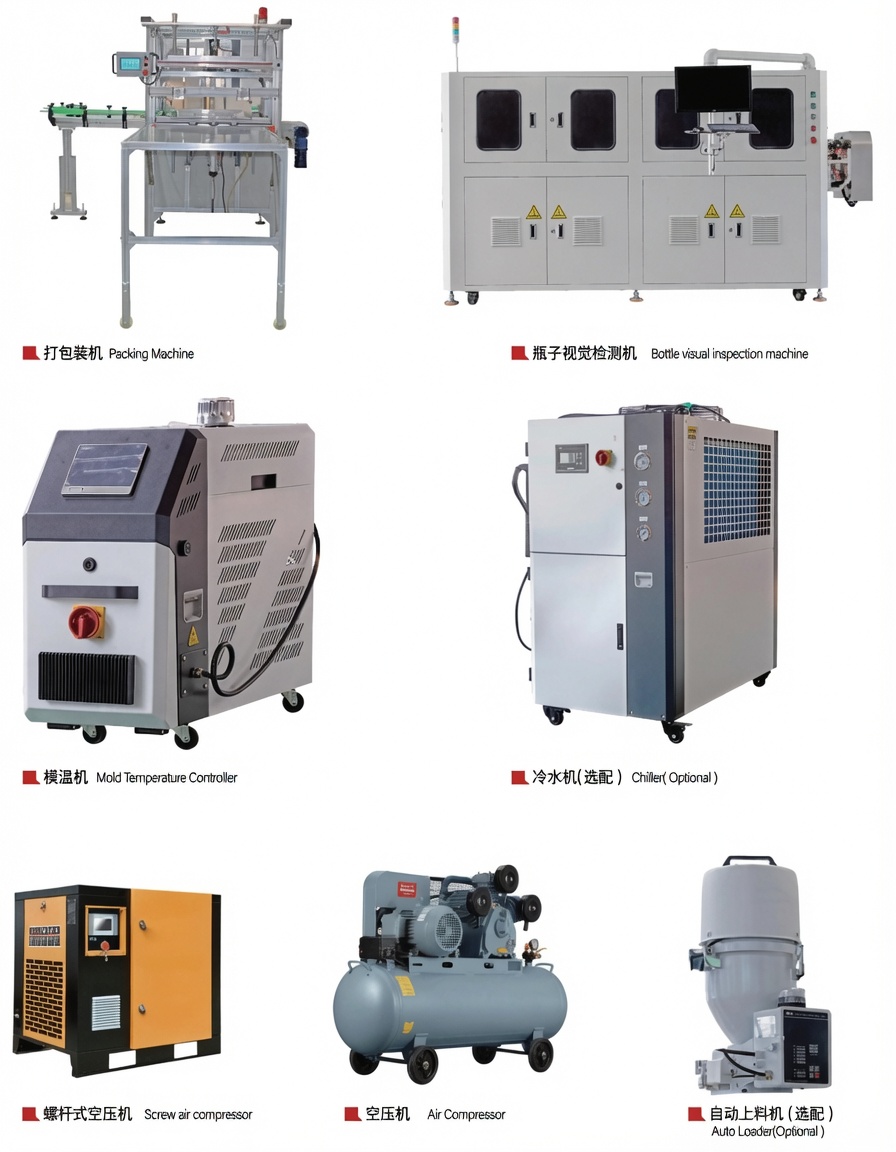
Dehumidifying dryers are non-negotiable for PET and PETG IBM processing, as already noted; for HDPE and PP lines, a basic hot-air dryer achieving -20°C dew-point is generally adequate. Mould temperature controllers — one circuit minimum per mould half on small tools, two or three circuits on multi-cavity tooling — maintain cavity-surface temperature within the ±2°C window required for consistent cooling and cycle time. Compressed air for IBM blowing should pass through a refrigeration dryer and coalescing filter to deliver a dew-point below -20°C pressure dew-point and a particle count below ISO 8573-1 Class 2, preventing blow-pin condensation and internal surface defects. Vision inspection systems — typically a four-camera station checking neck finish, wall opacity, base integrity, and body diameter — complete the quality assurance loop for pharmaceutical IBM production lines in the UK, enabling 100% container inspection at full machine output rates.
Frequently Asked Questions — IBM Blow Molding Machines (UK)
How long does an IBM blow molding machine typically last before it needs major refurbishment or replacement in a UK manufacturing environment?
A well-maintained IBM blow molding machine operating in a UK pharmaceutical or cosmetics production environment typically delivers 15–20 years of productive service life before requiring a major mechanical rebuild. The key longevity factors are preventive maintenance discipline, hydraulic oil quality management, and the timeliness of wear-part replacement on injection barrel and screw, core rods, and mould cavity inserts. Servo-hydraulic drive systems generally outlast fixed-displacement hydraulic systems due to reduced thermal cycling of the oil. Ever Power machines are designed and built to a 20-year service life standard, with stainless-steel hydraulic manifolds and hardened-steel core rods that resist the corrosive effects of PVC and flame-retardant resin additives. Annual planned maintenance contracts — available through UK-based service agents — are the single most effective way to maximise IBM machine lifespan.
What is the approximate price or cost of a new IBM injection blow molding machine from a reputable supplier in the UK, and what factors most affect the final quote?
IBM blow molding machine prices vary significantly depending on clamping force, cavity count, drive type, and the extent of customisation. Entry-level IBM machines for 2–8 cavity configurations in the 50–150 ml range typically price between £45,000 and £85,000 (ex-works). Mid-range 16–24 cavity platforms such as the ZQ110 fall in the £90,000–£150,000 bracket, while fully customised 32-cavity pharmaceutical-grade IBM machines with servo-hydraulic drives, conformal-cooled tooling, and IQ/OQ documentation support can reach £200,000–£350,000 landed and installed in the UK. Factors most affecting the final quote include: cavity count and mould complexity; drive technology (hydraulic vs servo-hydraulic); cleanroom-grade guarding; hot-runner manifold specification; and the level of commissioning and validation support contracted. Contact Ever Power at [email protected] for a detailed technical quote based on your specific container specification.
Which IBM blow molding machine supplier in the UK or internationally can provide pharmaceutical GMP-compatible equipment with full IQ, OQ, and PQ documentation support?
Ever Power is among the IBM equipment suppliers who actively support UK pharmaceutical customers through the IQ/OQ/PQ validation process. Ever Power’s project engineers are experienced in preparing and reviewing validation master plans, user requirement specifications (URS), and Factory Acceptance Test (FAT) protocols in accordance with GAMP 5 guidelines and MHRA inspection expectations. The ZQ110 and ZQ135 IBM machines are equipped with calibrated measurement instrumentation, PLC data-logging for critical process parameters, and alarm management systems that satisfy ALCOA+ data integrity principles. UK pharmaceutical converters in Sheffield, Wrexham, and Cambridge have completed successful MHRA-audited IBM installations on Ever Power equipment. Contact the technical sales team to discuss specific validation documentation deliverables before purchase.
How does an IBM blow molding machine compare with an ISBM machine when producing small pharmaceutical bottles in Birmingham, and which process is more cost-effective for volumes under 5 million per year?
For volumes under 5 million containers per year in the 10–150 ml pharmaceutical range, IBM is typically more cost-effective than ISBM for several reasons. IBM tooling investment is lower per cavity because there is no separate preform mould and blow mould pair to commission — preform and blow tooling are both integrated into the IBM machine’s on-board mould set, and there is no preform storage silo or reheat oven to purchase, commission, and maintain. IBM also produces no trim waste, reducing polymer cost per container by 2–4% compared with ISBM (which produces no waste either but does require reheat energy). For Birmingham pharmaceutical packers handling multiple container formats in short-to-medium runs, IBM’s fast mould changeover — under 45 minutes on a well-designed machine — supports a flexible production schedule that ISBM’s longer setup and purge requirements cannot match economically.
Where can I find a reliable IBM blow molding machine distributor or after-sales service agent covering Sheffield, Birmingham, and the wider North of England?
Ever Power supports UK customers through a combination of factory-direct technical sales and a network of trained service partners covering the major UK industrial regions including South Yorkshire (Sheffield), the West Midlands (Birmingham, Wolverhampton), the East Midlands (Leicester, Nottingham), Greater Manchester, and the North East. Service coverage includes planned preventive maintenance visits, emergency breakdown response, spare parts supply from a European logistics hub with typical 2–4 business day UK delivery, and remote PLC diagnostics for internet-connected machine installations. For service enquiries or to request a site visit from an Ever Power technical representative, reach the team directly at [email protected].
What is the expected lifespan and durability of blow molding machine tooling — specifically IBM injection moulds and blow moulds — and when should they be scheduled for replacement in UK production?
IBM injection moulds and blow moulds fabricated from P20 pre-hardened tool steel typically deliver 1.5–2.5 million cycles before cavity dimensions drift outside the original tolerance band and refurbishment or replacement is indicated. Hardened H13 steel inserts extend this to 3–5 million cycles at higher initial tooling cost. Core rods — the most wear-critical IBM tooling component due to the sliding contact during preform ejection — are typically scheduled for dimensional inspection at 500,000 cycles and replacement at 1.5–2 million cycles on HDPE lines, with shorter intervals on abrasive-additive-containing resins. UK IBM processors running high-volume pharmaceutical lines should implement a tooling asset management system tracking actual cycle counts, dimensional gauging records, and maintenance history per cavity. Ever Power offers tooling audits, refurbishment, and replacement rod and cavity sets as part of its after-sales programme.
How can a UK cosmetics packaging buyer get a fast quote for a custom IBM machine configured for PET serum bottles, and what lead times should they expect from order to delivery?
UK cosmetics packaging buyers can initiate an IBM machine quotation with Ever Power by emailing [email protected] with their container drawing, resin specification, required output rate, and any cleanroom or validation requirements. Ever Power’s technical sales team aims to return a budgetary quotation within 3–5 working days for standard configurations and within 10 working days for custom-engineered platforms. Lead times for standard ZQ110 and ZQ135 IBM machines run 10–14 weeks from order confirmation, including machine build, factory acceptance testing, and shipping. Custom configurations with bespoke hot-runner manifolds, modified platen geometry, or cleanroom-grade builds typically require 16–20 weeks. Expedited schedules are available under specific conditions. All quotes include Ex-Works pricing with UK DDP (Delivered Duty Paid) options available via Ever Power’s freight forwarding partners.
edit by gzl